Category: Graduate School

  • BFGq55PCQAAdtaQlarge

    I picked up my regalia and graduation tickets today. I still wouldn’t say that I’m excited, but it will feel good to have this one program finished and behind me, allowing me to concentrate on more broad areas of sociology (and information technology, if I so choose).

  • The Uneventful Graduation

    I have been graduated in the form of being conferred an academic credential a total of 4 times in my life so far. High school, two associates (AA, AGE) and my Bachelor of Science in Psychology. High school was a big deal in terms of a recognition of a terminal point being reached and a certain linear trajectory and certain social setting coming to a close. My associates degrees were earned by accident. I took courses and eventually had the right number of hours in the right subjects, so it took me one semester to finish the two degrees once I recognized the requirements were lined up to complete. My B.S. did not feel like a huge accomplishment to me because I took a long meandering journey toward completing it. It was planned, and so I was excited to finish it, but it wasn’t as direct or timely as I would have liked.

    I am due to graduate with my graduate certificate in gender, sexuality and women’s studies in May 2013. I am not as excited about this particular graduation as I could be because I do not see my work as being concluded. While it is true that I have completed the coursework (or actually 6 hours beyond minimum), I still feel as though I still have a lot of work left to do in gender studies. In fact, it is likely that concluding the certificate will not be the end of work in gender for me at all, as there will likely be ongoing work in the topic under the banner of the master of arts in sociology. Regardless of my feelings about the finality or not of this particular curriculum I intend to go through with the ceremony.

    Why go through the trouble of the ceremony when I feel like I do? For myself the reason is to force myself to occasionally acknowledge that I do accomplish things and that everything in my life is not simply a work in progress. I can and do complete things. The other reason is family. I may not like most of my family most of the time, but they have shown themselves to be somewhat interested in my life and therefore, after events surrounding the conferral of my two associates degrees I feel like I should perhaps go through the ceremony for their benefit. If for no other reason, I get a reason to drag a few key people in my family that I do like, to my campus to show them around.

    I want to be excited about graduation, but at this point I am too involved in other things going on in my academic career.

    462 Days Until Thesis Defense!

  • Objectives for the Spring 2013 Semester

    Spring 2013 is my second semester as a Masters student and my third semester as a graduate student. I am presently enrolled in four graduate programs: Master of Science in Information Technology, Master of Arts in Sociology, Graduate Certificate in Cognitive Science and Graduate Certificate in Gender, Sexuality and Women’s Studies. I have been told that I am crazy for having this number of programs, but to me it all seems very reasonable and logical. Each certificate is an integral part of one of the master’s programs as far as I am concerned. I cannot perform sociological thought without the consideration of gender, and I cannot consider information systems without cognition or cognitive thought. It all just fits for me.

    This semester has been very hard for me to establish in terms of scheduling. There were many interesting courses on the schedule for the semester and I found myself having to determine what my goals are before I could develop my own final schedule.

    One of my goals for this semester is to complete my WGST graduate certificate. There are several reasons for this. The most important reason I want to finish is this semester is that I feel that I have mentally “completed” the certificate. In May I will have been with the program for two academic years, long enough to have gotten a Masters in the topic. While I have not taken all of my courses in that program, I do feel like I have gotten almost a Master’s level of understanding from the program. As I work toward completing Theoretical Approaches to Gender this semester I will be working toward my 18th credit hour in the area of study (only 12 are required). Only 15 of the hours are recognized as being “in the program”, but my tutorial in sociology on the subject of the sociology of masculinity was certainly a good introduction to the “other side” of feminist thought. I am ready to put this program behind me and treat it as a building block for future work I may do in the social sciences. The next priority for finishing this semester is doing so will alleviate a problem with my academic record that has resulted in my cognitive science certificate not being on my electronic student record. Graduating the one certificate will allow me to have space for the other certificate. Finally, now is the right time to finish the certificate because the stability of the schedule for future classes being offered to complete the program is in question. Also, the next course offered that I could use to finish off the program will be taught in the same semester in which I am due to complete my thesis, so my scheduling options would be very tight.

    Another goal I have where my schedule is concerned is to take a class in the Information Technology program. I am taking Complex Adaptive Systems to accomplish that goal, but ironically it also has potential use as a method of sociological examination. Once again all of my departments overlap and align themselves to fit what I need. Complex Adaptive Systems also applies to the cognitive science certificate, so I will be taking out multiple goals with this course.

    I initially wanted to take both of the remaining “required” courses in SOCY, but I considered that perhaps that would be too much. I am instead taking one of the course, “Issues in Social Research”, or as it is called in the department “Research Methods” and I am also taking a research-oriented course that is specialized. It is a one-time-only “field experience” course that involves an active research project that the faculty are working on. Research methods will likely be interesting just because of the breadth of material that we cover. I am looking forward to the field experience most though because it is actually an opportunity to be involved intimately in the department.

    A non-class related goal I had for the semester was to get a graduate assistantship (GA) on campus. I wanted to find a way to become professionally involved in academics, and that is certainly a way to enter at the base level. That particular goal seems to now be completed since this morning I accepted a research position with the J. Murrey Atkins Library on campus. It is only for one semester, but I think it will be an interesting introduction to academic work.

    Finally, I have two goals related to my academic programs that don’t directly involve coursework. I hope to establish my thesis topic for sociology generally this semester, and also hopefully my specific research question. I also wish to write the concentration proposal for the Information Technology degree.

    So far things are shaping up to be the start of a very interesting semester. I hope things remain as calm and rational as they are right now, but I know they won’t.

  • A Postmodern Sociology

    During my year in the Gender, Sexuality and Women’s Studies graduate certificate program I encountered critical theory, postmodernism and poststructuralism numerous times. It just goes with the territory. It is difficult to study gender or sexuality without being able to deconstruct it and the best tools for that are provided by postmodern thought. Deconstructing the history that has been created is carried out through Derrida. Deconstructing the language that backs that history is carried out through Foucault. Deconstructing the performance of the history and the linguistic elements are carried out through Butler.

    Now, on the first day of my second week of the Master of Arts in Sociology I am reviewing articles related to my potential thesis topics and discover that all four of the articles that I pulled make some reference to critical theory or postmodern thought. It seems that I have come across the area of theory that is actually applicable to my areas of interest. I react to this with both anxiety (because I am somewhat perplexed by critical theory) and relief (because this is one less new thing to learn).

    I have been contemplating what my actual area of interest is given that I identify most closely with social psychology (and came from a psychology program), and am intrigued by deviant behavior, gender and sexuality. After spending some time reading on one area of social psychology, identity, it seems that I’ve found where everything converges in a way that makes sense. The social psychology of identity is a broad enough topic to allow me to explore a large amount of my interests in a cohesive way.

    Currently I am thinking I would like to focus my research on the social construction of identities and separately on deviant identities. There are probably ways to approach these topics within the positivist and quantitative scopes, but I find myself drawn more to the theoretical aspects of postmodernism, they allow for something that I perceive to be more meaningful than generating statistics about a group or behavior set and then attempting to classify based on it. In my limited social training through gender studies I have found that creating classifications or separating people based on numbers leads to discrimination and attempts to prove that people in the numerical minority are somehow inappropriate or bad because they don’t conform to the same behaviors and thoughts as the majority. Critical theory, postmodernism and poststructuralism defy the constructions of rigid barriers and challenge the authority of the majority, calling into question their version of history and the linguistic constructions with which they attempt to define the world for everyone.

    At some point my mission in sociology became not one of social research or analysis of social institutions, but of constructing discourse which promotes greater social justice and breaks the barriers of power which currently deny the existence of so much of the social capital that exists.

  • Becoming A Junior Scholar

    Monday morning at 11am I went to the University for a sociology orientation. I was uncertain of what to expect from this first encounter with the faculty and my cohort. Almost immediately it was confirmed that my understanding that I was one of six selected was correct. I am the type that typically likes to be quiet in large groups and typically have a hard time opening up in small groups, so at first it was a little intimidating, but it turns out that my cohort is quite friendly and most of us have at least something in common.

    Most of the orientation was rather uninteresting outside of the “getting to know the cohort” stuff, with the exception of a visit from our department chair. She started off her introduction to the group by requesting that we not call her by her doctoral title, but instead call her by her first name. This concept was not entirely unfamiliar to me, as some faculty prefer to be less formal. She went on to explain however, that her undergraduates are expected to call her by her doctoral title and that only her colleagues could call her by her first name. She prefers to think of graduate students as “junior scholars”. After spending the previous year in a graduate certificate program this transition did not occur to me, I did not consider that one of the key differences between undergraduate and graduate work was the level of engagement with the department and the institution. I am no longer merely a student, I am now a junior scholar, with all of the benefits and responsibilities of that status.

  • Why Sociology?

    My academic interests to this point may not scream that sociology is the logical choice for me, but I do feel as though it is a good fit. The programs I considered at the same time as sociology were counseling and a liberal studies degree. Counseling was and is my first choice, but things just did not align for that, so I am restricted to a more academic pursuit. In retrospect I was drawn to counseling because of status and stigma, I am not drawn to it as an academic discipline as I am with sociology.

    So, why sociology? Sociology is the academic discipline that is able to contain all of my academic interests neatly in a single program. Mental health and psychology do not cover my interests in social customs such as marriage and religion. Psychology treats my deviant behavior I interests as things to be treated and not things to be understood in a social context. My belief is that most behaviors and factors that affect daily life are based in some form of social learning or socialized construction. For this reason sociology interests me and is an academic discipline that I feel strongly toward. I feel that I can benefit the field of sociology and I feel that it can benefit me.

    I will have a hard time trying to decide what I want to put the most emphasis on in my degree as there are so many areas that draw me in.

    Deviant behavior is a big area for me. I am interested in it generally from the aspect of why deviant behavior exists or why deviance is a classification of behavior. I am also interested in the cultures of deviance such as those involved in fetish and sadomasochistic communities. A key question in this area is "why do non-conforming people form communities?".

    On the other side of deviance is the conforming world of family, marriage and religion. Religion fascinates me because I don’t have one and thus the social forces involved in religion is a total mystery to me. From my first sociology class as an undergrad (in 2004) I have contemplated the meaning of family and the origins of it’s definition. I suppose my question here is: "what is a traditional family and why is the concept of the traditional family perceived as critical to social cohesion?".

    Why sociology? I am intrigued by structural systems of power and their influence on the individual.

  • Accepted to Master of Arts in Sociology

    Fall2012Program

    I was simply checking my grades today and reviewed my academic transcript and found that my primary program had changed since my last visit. My primary major was listed as “sociology”. I opened up the status of my application to reveal “decision made”. It seems as though I am now a Master of Arts in Sociology student.

  • Mastering My Options

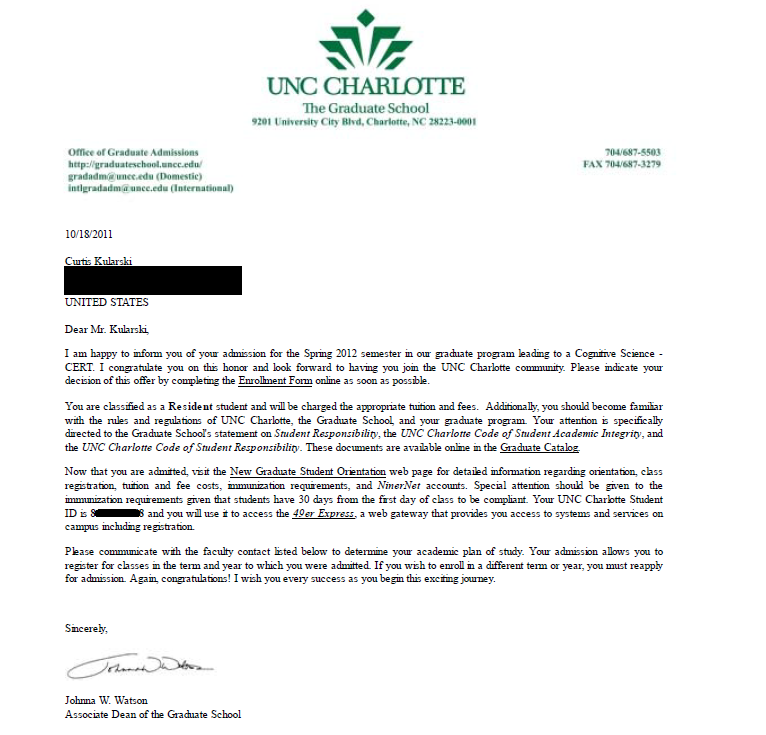
    I began my adventure into graduate-level coursework with a simple plan: take a graduate certificate in cognitive science, complete a Master’s degree in Clinical/Community Psychology, and then get my Ph.D. in Clinical Health Psychology.

    Every bit of this plan has been skewed. Initially I was rejected by the cognitive science program because I did not have a clear plan of what I wanted to accomplish with it, then I decided that the Clinical/Community Psych program was basically for stiff over-achievers, which also nullified the Clinical Health Psych Ph.D. idea for me.

    What has now occurred is I was admitted to Gender, Sexuality and Women’s Studies (WGST) instead of Cognitive Science (GCOG), then I was admitted to Cognitive Science as well. Now I am in both programs and intend to complete both of them. The hole this leaves open in my plan is that I no longer have a narrow focus. I was originally going to primarily focus on the human cognition side of cognitive science, as I had long ago left computer science behind, and then move on to a mental health field. Now, the WGST program has exposed me to so much social science and social issues material that I don’t want to work on Cog Sci from the perspective of a humanities program, I want to approach it from the computer science side a bit, although from more of an information systems perspective than true computer science. Also, WGST has renewed my interest in social sciences, but not necessarily from the perspective of psychology (which tends to be an overly general field of science). After all of these changes, what Master’s program do I need to be in? Where do I fit?

    I have been asking myself that question for the last several weeks as admissions deadlines have become closer. I have applied to counseling and sociology, and I know I could be happy in either of those fields, but I worry about my chances of being admitted as well as my level of fit with the programs. For counseling I will know by the end of the month if I have been rejected (but I won’t know until March or April if I have been accepted). For sociology, I guess it is up to Dr. Moller to decide when I will know my fate. As for my other concerns, I have been looking into several different programs, trying to determine where I fit in and what will work best for me.

    • Master of Arts in Counseling – this program is the first that came to mind after giving up on C/C Psych. It encompasses everything that I like about psychology, but leaves out some of the more morally concerning aspects (such as dependency on diagnostic labels). My fear with this program is that it is practicum based, not thesis based. I can complete a thesis if I like, but the program is not designed for that outcome. I fear I will have to give up my research interests for a purely instructional education style. Also, there are rules for the program requiring “professional dress”. I think this is an interesting thing coming from a counseling program. I am all for dressing cleanly and presenting a positive image, but I do believe that ultimately in a graduate program, we are just students and should not be subjected to that type of requirement.  The final concern I have is that the program is 60 credit hours. That is a lot of hours for a Masters program. Most are from 30-45 hours. In the time it would take me to complete the MA in Counseling I could complete 2 other programs, or a single MA and have a strong start on a Ph.D. program.
    • Master of Arts in Sociology – this program became option #2 after I started getting into gender studies and things of that sort with the WGST program. It will allow me to engage in thesis research and follow topics of personal interest in the field of sociology. I feel like I am a good fit for the program, but the low number of seats available makes me question my chances of being admitted. Still, I desperately want in to this program. It seems like the best place for me with the highest chance of me completing with my personality intact.
    • Master of Science in Information Technology – this program is sort of funny for me. I ran from this department (Software and Information Systems) in 2007 and didn’t look back. I did not enjoy my initial time in the department, but this program grabs my eye. It is interesting and covers primarily topics that excite me, such as Human Computer Interaction and Software Design. The program is very flexible, with the option of completing a concentration or a thesis. It is conceivable that I could complete this program with a concentration of cognitive science (using the thesis option) and build upon the graduate certificate.
    • Master of Arts in Liberal Studies – this program is and has been defined for a long time as my backup plan. If all else falls through, this is where I can put my effort. This program is open-ended. I can design my program however I want and fill it with whatever courses I want. The program is completed with a thesis or a project, so that works out, but I’m not entirely sure where it fits in my overall plans. One thing I have considered with this program is applying to it even if I do get accepted to another program, having it as a place to put my special interests. If I am admitted to sociology or counseling it is a place to put an extension of my work in cognitive science, if I am admitted to Information Technology it is a place to put an extension of my work in gender studies.

    There is a sense of urgency for being admitted to a program. Most programs admit only once per year, in Fall, and there is a concern regarding the number of hours I accumulate. I am only allowed to transfer 6 hours into any program that I am admitted to, even though it is at the same institution. The good news is that if I am admitted into 2 programs, I can transfer 6 hours into each program, but at 9 hours per semester, that doesn’t go very far. I am prepared to accept that each of my certificates will hold 6 hours that do not get allocated to any other program, so that’s 12 hours I don’t have to account for, but by the time I have 24 graduate hours (12 + 6 for each MA)  I need to have a clue what I am doing as far as a Master’s program. Another concern, although more minor, is that I only have 6 years from the first credit earned toward a program to complete the program. As I have already completed hours toward sociology, electives for counseling and have started on hours toward the IT degree the clock is already running on my hours. Additionally, any hours that I wish to transfer to a doctoral program must be used within 8 years of being earned, but that is a lesser concern because they will likely be upper level hours completed in a master’s program.

  • Application Submitted

    20111128-210448.jpg

    I have filed my application for admission to the Master of Arts in Counseling program. Now I get to wait nervously for the admissions panel ands graduate coordinator to do their work. If the application is in line with the type of candidate the program is looking for, then I should be invited to an interview in January and things proceed from there.