Category: Academic

  • A Most Pleasant Advisor

    This blog is full of rants and raves about problems with my advisors. In general I have found advisors to be a pain and a general road block to academic success in most situations. It seems as though I have adapted to one of my advisors in a way that has formed a much more functional relationship.

    Its not the typical thing that I think about most of the time, and it did not even occur to me until I realized that I was going to have to be assigned a replacement advisor that I had become so attached to my current advisor. Dr. Allen is my advisor for my B.S. in Psychology program. I went through 3 other advisors before her. My first advisor was assigned when I declared my major. Unfortunately, we didn’t exactly get along. She wanted to advise me by phone only and give my advising PIN by phone as well, and our schedules didn’t really match. I requested that she be replaced, and she was replaced by another advisor, but unfortunately, he left the university a semester later and I was finally assigned to Dr. Allen.

    Dr. Allen has basically given my free-reign over designing my curriculum and even supported my goofier academic endeavors (such as becoming a sociology minor and taking an entire course sequence to take an SPSS course). With Dr. Allen, I have always known that I was in charge of my academic plans, but she has always been there, advising me of potential pitfalls and problems that can occur. She has been like the perfect advisor to me.

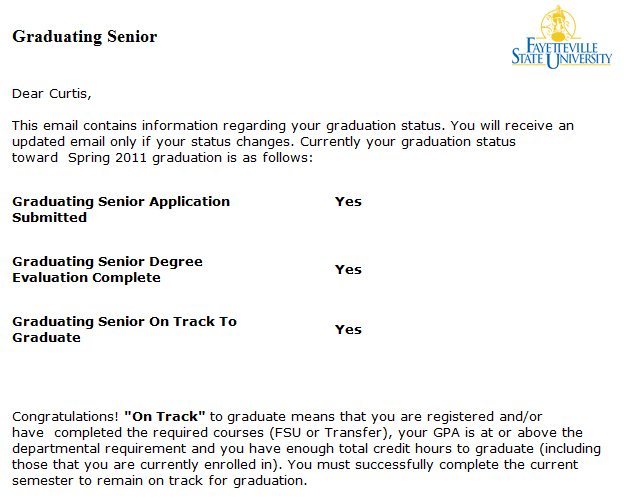
    Now, as I prepare to graduate, and work towards a B.A. in Sociology during the summer I face the fact that there are only a few weeks left with Dr. Allen as my advisor. Actually, in a few days I expect to be notified of who will replace her as my advisor of record.

    While it is true that I probably could have functioned without the support of an academic advisor, it has been very reassuring to have access to Dr. Allen when I needed her, especially when I couldn’t quite take care of things with the registrar’s office the way that I needed to.

  • The Torture of Admissions

    I know very few processes that have the same level of stress, anxiety and anticipation as the process of applying to an academic program. To individuals that desire to pursue education, an admissions decision is a big deal. The decision of an admissions committee (or a program coordinator) can alter the outcome of a person’s life. That one little decision makes all the difference. Neither decision is particularly bad, admitted or not admitted, it doesn’t seem to matter, but they have a profound impact on a person’s life. Being not admitted to a program that an individual is a good match for and being admitted to a program that an individual has no chance of success in are equally bad outcomes. It is possible for dreams to be crushed, but it is also possible for people to discover what their potential truly is and perhaps think outside of their comfort zone. To the applicant all that matters is acceptance. Everyone wants to be accepted, in some form or another.

    I am presently more nervous than I have been since I began the application process. My application to Cognitive Science has been decided. All I know about it at the moment is that my application’s status is “DECISION MADE”. No further information is available. This is where the torture begins. I am informed by the graduate school that the decision letter will be release in the next 24 hours. The decision letter contains the actual answer to whether or not I am admitted. If I am accepted, it will also contain an offer of admission, which I must accept or decline (if I’m accepted, there is only one possible response to that question). There is just something extremely torturous about knowing that the decision has been made, but having absolutely no access to that information. 

  • Restructuring a Dream

    I began this semester planning for how I was going to move on to graduate school. My original plans were pretty simple, apply for program X (clinical psyc), if denied, move on to program y (academic psyc). As with all of my plans, there are backup plans for the backup plans. The essence of my desires have changed somewhat.

    I still have my absolute last-resort backup plan in case no grad schools want me, the Bachelor of Arts in Sociology program. It would give me a chance to expand my academic record to further prove my academic abilities. I’m not too worried about admission for this last-resort plan, since according to the admissions office at Fayetteville all I have to do is “come over to the office after graduation and tell us you are ready to come back”. Apparently its as simple as that.

    The restructuring comes with me taking a look at my goals and my abilities and creating a realistic, workable plan for graduate education for myself. First of all, I may have the pre-requisite knowledge for a master’s in clinical psychology program, but in some ways I would like to be a little better prepared when I go in. It’s a competitive program and I’m going to have to kick ass to get into it. As it stands, I’m not a good competitor for those 5 seats in the program for this year. The Academic Psyc program at ECU sounds good as an alternative on paper, but it’s not where I want to be, its not the program that I truly want to be in. The Academic Psyc program would be admitting that I am defeated and would result in academic stagnation for me. As for the original 3rd option, the graduate program in Liberal Studies, I think I would enjoy it, but I would prefer to hold off and take that degree when I’m 80 and can truly put life experience behind it and enjoy it. My new restructured plan does not have 10 layers of redundancy like the original plan, but requires a bit of faith in myself and my abilities, as well as a belief in luck and the wisdom of the academic process.

    My new restructured program is fairly straight forward. The first part of the program is a graduate certificate in Cognitive Science. The program is focused on cognition and thought processes, both human and computer. It’s a melding of curriculums for me. My absolute dream curriculum. The program is just a certificate, so it will likely only last a year for me, just long enough for me to gain some more experience and learn to interact well with other students and faculty. After completing the Cognitive Science program I intend to apply to the doctoral degree in health psychology (community focus). While in that program I would very much like to pursue another certificate program, this time in the computer science field of game design and development. I think that combining the two programs would give me a good handle on the areas I would need to be familiar with to design games and other computerized tools for psychological assessment or research.

    Perhaps my goals are a bit too lofty, and perhaps some things are still a little too unrealistic. I don’t know for sure, but I do know that this is what I want and its what I’m going to go for. I am not going to build my education based on my second choice, and I am certainly not going to be told that I am not good enough for something that I am passionate about.

  • Waiting for White Smoke

    I don’t like rejection, but I hate waiting.

    I have submitted the first of my graduate school applications, the one for Cognitive Science. My admission to this program will determine if I complete my application for Clinical/Community Psych at UNC-Charlotte. Ideally I would be accepted into both programs and could immediately work towards my goals. I have communicated a little with the graduate program coordinator for Cognitive Science, including immediately after submitting my application last Tuesday. Unfortunately for my nervous habits, she stopped responding last Tuesday as well, just after saying something about my application missing the statement of purpose (which to my knowledge it was not). Its been nearly a week since I last heard from the graduate coordinator, and she sort of left me hanging with the statement of purpose question. I have also contacted the graduate school admissions staff to see if perhaps they can track down the problem, or the graduate coordinator (I will restraint myself from making the obvious joke there, as I am trying to conduct myself more like a graduate student). Luckily I am not having to wait on a panel of cardinals, this time, just a single individual who will decide if I am a good fit for a program that involves computer science, psychology, philosophy and language. In some ways I think I would be more comfortable if this particular admission decision was being made by a panel, as then I would at least not feel like I have to walk on eggshells as to avoid offending or irritating the one person who is control of my admission to the program.  I am not usually a superstitious person, but for things like this I am. I am not walking under ladders or making any type of concrete plans just yet, not until I know one way or another. I suspect the next things bothering me is the timing. I have applied for the Summer semester, which has a materials deadline of April 1, but each program has its own decision cycle. For the Clinical/Community program I know that I should know something by April 15th, but this one is a little more loose-ended. I am honestly hoping for a decision before the week of March 28th so that I can register on time for classes for summer and fall (since there is only 1 class available for summer for the program).

    At this point I am waiting. I am waiting for an admissions decision. I am waiting for a reply.  I am waiting for any little hint of being able to make stable plans for my academic future.

  • Cognitive Science Plan

    Courses required:

    PSYC 6216 Introduction to Cognitive Science (3).
    This course presents multiple perspectives on the study of intelligent systems. Broad coverage of such topics as philosophy of mind; human memory processes; reasoning and problem solving; artificial intelligence; language processing (human and machine); neural structures and processes; and vision.   Also included is participation in the cognitive science seminar (Same as ITCS 6216, and ITIS 6216) (Fall Semester).

    Courses selected as part of the core:

    ITCS 6150. Intelligent Systems. (3)
    Prerequisites: full graduate standing or consent of the department. To introduce core ideas in AI. Heuristic versus algorithmic methods; problem solving; game playing and decision making; automatic theorem proving; pattern recognition; adaptive learning; projects to illustrate theoretical concepts. (Fall) (Evenings)

    PHIL 6630 – Philosophy of Mind (3).
    This course addresses questions concerning the relationship between body and mind, the existence of other minds, the nature of consciousness, and the architecture of cognition.  Approaches to these questions include traditional philosophical sources (emphasizing metaphysics and epistemology) and more recent developments in cognitive science (including the computational model of mind, mental representation, connectionist systems, and artificial intelligence).  Also addressed are ethical and social issues involved in the design and implementation of intelligent systems.  Inquiries bear on issue such as free will and determinism, emotion and reasoning, and the nature of rationality.  (Regularly)

    Courses selected from “topics” selection:

    ITCS 6156. Machine Learning. (3)
    Prerequisite: ITCS 6150 or consent of the department. Machine learning methods and techniques including: acquisition of declarative knowledge; organization of knowledge into new, more effective representations; development of new skills through instruction and practice; and discovery of new facts and theories through observation and experimentation. (On demand)

    ITCS 6170. Logic for Artificial Intelligence. (3)
    Prerequisite: ITCS 6150 or consent of the department. Introduction to basic concepts of logic for artificial intelligence, including declarative knowledge, inference, resolution, non-monotonic reasoning, induction, reasoning with uncertain beliefs, distributed information systems, intelligent information systems, planning and intelligent-agent architecture. (On demand)

    Capstone Course:

    PHIL 6920 Thesis.  (3)  Appropriate research and written exposition of that research is required.   (Upon Approval of Department Graduate Committee).

    Spare Courses of Interest:

    ECGR 5196. Introduction To Robotics. (3)
    Prerequisites: ECGR 2103 or MEGR 2101 and senior standing. Modeling of industrial robots including homogeneous transformations, kinematics, velocities, static forces, dynamics, computer animation of dynamic models, motion trajectory planning, and introduction to vision, sensors and actuators (dual-listed with MEGR 4127).

    PSYC 6116  Cognition (3).
    Concerned with how humans acquire information, retain  information in memory, and use this information to reason and solve problems.  Current emphases include memory, category learning, planning, concept formation,  problem solving, mental models, and knowledge representation. (Alternate Years)

    ITCS 6153. Neural Networks. (3)
    Prerequisites: ITCS 6114. Topics include: Basic notions and models of artificial neural nets; single layer neural classifiers; multilayer one-way neural nets; single layer feedback networks; neural models of associative memory; self organizing neural nets; translation between neural networks and knowledge bases; applications of neural networks. (Even, Fall) (Evenings)

  • Chain of Possibilities

    I’m a little nervous about getting into graduate school, so I have a chain of possibilities that I am planning to use.

    In order of priority, my options are:

    1. Master of Arts in Clinical/Community Psychology (UNC-Charlotte)
      limitations: only 5 students accepted
    2. Master of Arts in Psychology – Academic Concentration (East Carolina University)
    3. Master of Arts in Liberal Studies (UNC-Greensboro)
      note: will likely attempt to enroll for summer
    4. Bachelor of Arts in Culinary Arts (Johnson and Wales University)
      note: post-bac degree
    5. Bachelor of Arts in Sociology (Fayetteville State University)
      note: post-bac degree

    I would obviously very much like to get into the Master of Arts in Clinical/Community Psychology, but since there are only 5 seats in the program for each entering class, my chances of getting into the program are quite low. The program is described as being “very competitive”. If this option falls through, I intend to utilize my 2nd option, the Master of Arts in Psychology with a concentration in Academic Psychology. If I am able to get into that program, I will likely reapply to the MA Clinical/Community program next year in hopes of getting in. I will have to be careful with what I select to take though, because if not, I will end up with 12 to 18 hours that I can’t use for anything. I already know that anything beyond 6 hours will be lost anyway, but if its what it takes to impress a graduate school admissions panel, then I have to do it. The Master of Arts in Liberal Studies I can’t really say much about, as it isn’t really in my field of interest, but it would offer me the ability to explore numerous academic options including computer science, philosophy and psychology. Again, only 6 hours could transfer, but if I can improve my record to become more appealing to the admissions committee, then it is worth it.  The two bachelor options listed are absolute last-resort fall back options. There is no benefit to joining those programs when it comes to getting into the Master of Arts in Clinical/Community Psyc program. The Culinary Arts degree is really more of a fantasy that would be put into motion if I have to resort to that option. Still, there is the requirement of being accepted. As a final option, there is the B.A. in Sociology which would be interesting, but still not put me any closer to the degree that I need, but unlike the Culinary Arts degree, it would put me on a track in which I would be destined to return to the social sciences. In some ways, that is less desirable than an excuse to activate the fantasy option, hence why it is at the bottom of the list. If I complete the Culinary Arts degree my path will change and I will not be in a position to return to Psyc (a very unpleasant thought).

    Ultimately my plan is to complete the MA degree (any of the three, but with priority given as listed above), and then apply to the Ph.D. in Health Psychology (Clinical or Community option) for Fall 2013. The MA in Clinical/Community Psyc places me in the most direct path to enter the doctoral program of my choice. 

  • Semester Projects

    Art History 1 (ART 114) – “Write a paper on the development of the human figure in Greek art.”

    Art History I (ART 114) – “Write your paper on the contributions of the Romans to modern Architecture and Engineering.”

    Sex and Gender (PSYC 430) – “Sex Differences in Domestic Violence Initiation”

    Crime and Delinquency (SOCI 340) – Applying Criminological Theory – topic not yet selected

    History of Sociological Thought (SOCI 350) – Group Project: Harriet Mantineau

    Sociology of Deviant Behavior (SOCI 360) – Routine Activities Theory

    Race and Ethnic Relations (SOCI 412) – Linguistic Assimilation in a Cross-cultural Situation

  • Too early to consider a graduate certificate?

    Well, on the topic of adding stuff to a graduate program of study, I’m about to contradict myself. You CAN add stuff to a graduate degree program, primarily through the use of a graduate certificate to take up any elective spots, and if correctly placed they can enrich the overall program. I am seriously considering adding Cognitive Science as a graduate certificate if I am admitted to the Clinical & Community Psyc program at UNC-Charlotte.

    Cognitive Science Program: http://cognisci.uncc.edu/content/view/3/2/