Category: Academic

  • The Dilemma of Class Selection

    I believe preparing for this upcoming fall semester has been the most difficult course selection I have ever had to make. I have been torn between a lot of different class options, all of them promising some joyous new intellectual avenue, but I only have space for a few.

    I know for certain that I am taking 2 courses in my program. WGST 6601 “Theoretical Approaches to Sexuality”, and WGST 2050 “Introduction to Gay and Lesbian Studies”. 2050 doesn’t directly correspond to a requirement in my program and is in fact an undergraduate course, but it is a course that interests me and Chris is willing to take with me. Beyond these courses, everything else is up in the air because of the fact that my program does not offer a lot of courses each semester, and with my area of gender studies being masculinity, the course selection is even crappier.

    I am pretty certain that I am also going to be involved in  SOCY 6895 “Tutorial in Sociology”, which is a directed research and readings course that will allow me to have a certain degree of flexibility in selecting a research topic that interests me and working on developing a certain level of expertise in it. The course is offered by the department of sociology, but I intend to work on a topic that is related to gender studies and tackle it from a sociological perspective. I am enrolled in the 1 credit hour tutorial, so it has a negligible effect on my schedule, while still exposing me to the department and its policies, as well as hopefully making a good impression on the faculty.

    The next course space is the one that is a bit flexible. It was my intention to have a course representing each of my potential programs for next year. I intend to apply to the Masters in Sociology and the Masters in Counseling programs. The counseling program offers a certain limited set of courses to students not officially admitted. I am trying to work inside the confines of those limitations. At the moment I have two options. First, an online course, RSCH 6101 “Educational Research Methods” and then second, a seated course, CSLG 6101 “Ethical and Professional Issues in Counseling”. The online course seems like it would be a good alternative to having classes three nights per week, in addition to having to work on my tutorial project.  Online classes can be a lot of work, but usually they have due dates sometime between Friday and Monday, making it not compete for resources with my other classes. Other things that come to mind are the restrictions that another physical class puts on me. That’s another 3 hours that I will have to be in a classroom at a set time, when I would love to keep things more flexible. However, CLSG 6101 is more in the department than the RSCH class, which is merely utilized by counseling, it is taught by the department of educational leadership.

    There are other courses that I would love to take, but have no room in my schedule for. PHIL 6050 “Topics in Phil: Social Justice” could have potentially applied to my program, but the course would have been a ton of reading and a level of thinking that I don’t think I am quite prepared for yet. PHIL 6240 “Research Ethics in the Biomedical and Behavioral Sciences” seems like it could have been an interesting course, but it has a lot in common with CSLG 6101, and would not actually apply to my program. The other course I wanted to try, but didn’t see working out was ITCS 5010 “Topics in CS: Computational Photography”. The course title got my attention and the description made me initially register for it, but after careful consideration of the type of work involved in the course, it seems to be something that is very technical and probably not good for my first semester as a graduate student.

    I am trying to keep my initial schedule between 9 and 11 credit hours. I know in undergrad I could do 18-21 hours without blinking, but these courses will mostly be in person, meaning they will take up more time and are less flexible and less forgiving. Also, these courses will likely be much more challenging. I want to be challenged, but I don’t presently feel like I can safely do 12-15 credit hours of graduate work, since I don’t know what I am getting myself into yet. In November when spring registration opens I will have a better idea of what the courses are like and what my capabilities are. I may find it easy enough to do 12-15 hours (in which case, I will do my best to seek dual-degree status in SOCY and CSLG), but at the moment I am not that optimistic.

    I didn’t enjoy my undergraduate life too much, I spent most of it being shy and not really getting involved in the campus. For some reason now I am very enthusiastic, looking forward to meeting people in my classes and I want to be involved on campus. Doing this will also take time that I would normally have for focusing entirely on class work.


  • Fall 2011 Courses

    I have delayed posting about my fall 2011 courses due to my program of study being somewhat indeterminate until recently. The schedule itself is still somewhat flexible, due to the fact that I have not yet consulted with my advisor about the final plan for my program.

    The graduate level courses I plan to take are the following:

    Philosophy and Social Justice [PHIL6050]
    Prerequisite: Permission of the department. In-depth treatment of selected problems and issues in philosophy. May be repeated for additional credit as topics vary.

    Covers theories of justice from Plato to Rawls and non-violent strategies in the civil rights movement, the women’s movement, the gay rights movement, and the issues relating to immigration and poverty/homelessness. Beyond using established historical and contemporary philosophical texts on these issues, the class has several guest speakers. — 3 hours

    Research Methods [RSCH6101]
    Identification of logical, conceptual, and empirical research problems; application of methods and procedures, including conducting library research, interpreting research findings, and preparing reviews of related literature. (Fall, Spring, Summer) — 3 hours

    Theoretical Approaches to Sexuality [WGST6601]
    An interdisciplinary examination of the history of sexuality and contemporary theories of sexuality and the body. Topics covered include historical aspects of sexuality; representations of sexuality; politics of sexuality; critiques of psycho-analytic approaches to sexuality; feminist engagement with biological constructions of sexuality; and queer theory. — 3 hours

    PHIL 6050 in its standard catalog definition does not count toward my program, but I intend to seek approval to use it in my degree program from the program director because the course focuses on two areas that are covered by my program, and contains concepts that could be beneficial to be knowledgeable of if I were to use a directed topics course to close out my program.

    RSCH6101 I know will not apply to my active program no matter what, but applies to other programs that I intend to go into in the future (primarily MA Counseling). Having the course already completed will benefit my application for the programs, as well as help me have some requirement already met. Taking this course also helps meet the requirements for being a full-time graduate student.

    WGST6601 is a core course in my current program. The course represents the primary reason I am in my present program.

  • Gender as a role?

    Gender is typically treated as  “role” in society. Unlike other roles, such as “student” or “postal carrier”, the role of gender is present in all aspects of life. Why is this the case? If gender is truly limited to a social role, shouldn’t it be something that only applies in certain locations and certain situations?

  • Last Minute Change

    In a crazy decision regarding what would be best for my academic career, I have decided to make an adjustment to my Summer 2011 semester at Fayetteville. The semester starts on Monday morning, and something about my schedule was bothering me. I have decided on a variety of factors to drop “Urban Sociology” and instead add “Advanced Composition”.

    I have only a minimal interest in Urban Sociology, and cannot at this time convince myself to dedicate my energy for summer to such a course. I do not particularly get along with the instructor, do not think I will be that interested in the course material and even if I were to complete the BA in Sociology program, the course would only count as an elective. Advanced Composition on the other hand, I have no knowledge of the instructor, except for a few emails that she and I have exchanged in the past, in which she seemed very pleasant. The course has no relevance to the degree program at all, but I do believe it will be useful in my upcoming graduate program, as well as in future academic pathways that I may find myself in. Perhaps this will also help me resolve my recent difficulties in expressing myself as clearly as I want in written form.

    I cannot recall a time in the past when I have made such a dramatic schedule change this close to the beginning of a semester.


    Advanced Composition [ENGL341]
    Trela N. Anderson
    A study of rhetorical strategies, sentence combining, editing, logic and persuasion, diction, usage, and research methods. — 3 hours

    Registered

  • Summer 2011 Course Descriptions

    Sociology of Gender Roles [SOCI400]
    Heather Griffiths
    A course examining the social determinants of gender role identity, with emphasis on the relationship between gender role identity and personality, personal and professional relationships, work, religion, and general culture, particularly the culture of the United States. — 3 hours

    Registered

    Urban Sociology [SOCI442]
    Jilly M. Ngwainmbi
    A study of urbanism as a way of life; the growth and development of urban areas; urban social organization; change and problems of contemporary urban life; ecological patterning; urban planning; and problems of control. — 3 hours

    Registered

    History and Culture of the Ancient Greeks [LBST2101]
    Dale Grote
    The History and Culture of the Ancient Greeks. This section focuses on the cultural achievements and historical experience of the ancient Greeks and their legacy to the West. The course is divided into four units: (1) Homer’s Iliad, (2) The Persian Threat, (3) Material Culture, and (4) Greek Philosophies. — 3 hours

    Active

  • Graduation Photos

    Chris has finished sorting and uploading photos from my graduation:

    http://www.flickr.com/photos/psychoticwolf/sets/72157626590557749/

  • May 12, 2011

    I haven’t made an actual post since graduation, actually, I haven’t made a real post since April 4th, which is a long time between substantial posts for me.

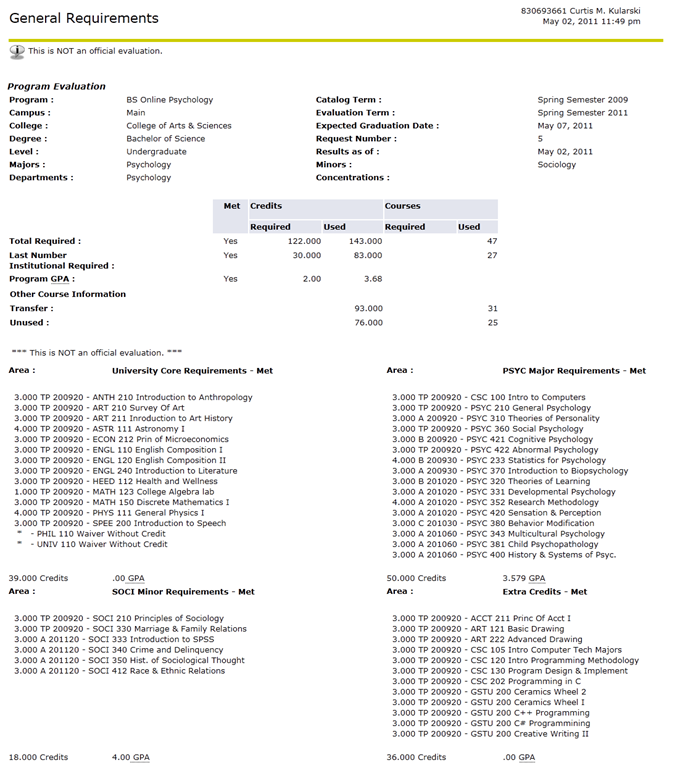
    First of all, graduation went well on Saturday. I now hold the degree of Bachelor of Science in Psychology, Cum Laude. While my courses at Fayetteville all ended on April 30th, my final exam for Art History (at Gaston) was not posted until Monday, and I completed it that evening. My semester is now complete.

    I’ve been asked several times if I feel different now that I have the degree. The simple answer is “no”, but yet there is a difference in the amount of pressure I feel. I don’t feel instantly more intelligent because I have the degree, but I no longer feel a pressure to get the “first” degree out of the way. I really don’t know why people think of it as my first degree though, since I do hold dual Associates degrees, and now a Bachelors, so this is really my third degree, but for some reason people like to see Associates degrees as not holding any value.

    At this point, it is a relief to be done with graduation. All of the effort toward getting cleared for graduation was stressful and because everything was in motion I felt the pressure to ensure that everything went smoothly. Before this semester I took my undergraduate education at a very leisurely pace, and preparing to graduate upset that pace. I suppose I am still a little in disbelief at the fact that it is done. All of the papers, exams and everything to get here just sort of suddenly ended last week and then in less than 6 days I was being conferred a degree. I’m very glad for those 6 days though, otherwise, I do not think that I would have been able to handle the ceremony and certainly would not be able to convince myself that I was really finished.

    I am still no more certain of what is coming up in the fall for me than I was a few weeks ago, but I am hopeful and ambitious. I know for certain that I want to remain in the social and behavioral sciences, but I’m not sure what paths are actually available to me. I have an open application for a program in Gender Studies and I have been told that my application for the Master of Arts in Sociology would be welcomed at Fayetteville, but I’m really not too enthusiastic about continuing on the distance ed path, especially not for graduate school. I have admitted to myself that the Clinical/Community Psychology degree program is not likely to happen for me, and besides that, I am not liking the overall attitude to the program, so I am instead leaning toward the Master of Arts in Counseling, which seems more accessible, as well as is more in line with my actual interests. I also leave open the option of a Master of Arts in Sociology at UNC Charlotte, beginning in spring, if I am admitted to the Gender Studies certificate program this fall.

    I am told that the future likely holds a lot of great things for me, I just don’t yet know what any of them are.

  • Spring 2011 Papers

    Spring 2011 papers are now released.

    image image
    ART 114 – Art History I
    Nude Form in Greek Art
    ART 114 – Art History I
    Roman Architectural Influences
       
    image image
    PSYC 430 – Sex and Gender
    Gender Differences in Domestic Violence Initiation
    SOCI 340 – Crime and Delinquency
    Jesse James Hollywood Analysis
       
    image image
    SOCI 350 – History of Sociological Thought
    Harriet Martineau (group project)
    SOCI 360 – Sociology of Deviant Behavior
    Routine Activity Theory
       
    image
    SOCI 412 – Race and Ethnic Relations
    Linguistic Assimilation