Category: Academic

  • Not The Only One Annoyed

    “Hello everyone; this is to let you know that I had uploaded grades in Banner after irritating insistence by the administration (they just send you an e-mail a day until you do it. Talk about negative reinforcement!). They also want me to remind you of the course evaluations.”

    This email just came in from Dr. Montoya. Apparently the faculty gets annoyed by the administration to do things as well. I am wondering if the process that controls everything at FSU is annoyance and irritation?

  • Rant: Letter to Office of IR @ FSU

    Dear Department of Institutional Research: 
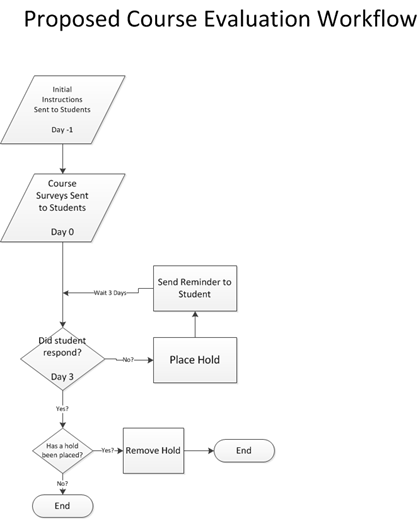
        Your department implements holds on a students records in a most unethical way. It is not part of a students responsibility to conduct an assessment of your faculty and at no time between admissions and registration for classes is such a responsibility communicated. You describe the process of registering early and viewing grades as some type of privilege that is to be given for successfully completing your surveys. Those are privileges that students have already earned by completing enough credit hours and otherwise being in good standing with the university. Your planned usage of an email every 3 days in any other situation could be called abusive.
        I will complete the surveys this semester, as I do every semester, but it is not because of your holds nor the "prize" of being able to view the grades that I have earned. I complete the surveys because I feel that it is important for students to give feedback on their instructors and the material in courses, it is part of how a university grows. I do however, believe that such a contribution should be voluntary and any results that are obtained through the types of coercion that you employ are tainted. It is not good scientific process to utilize any type of negative sanction to encourage participation in a survey or study of any kind. If you are having difficulty getting responses without such coercion, perhaps it is time to adapt your methods or perhaps adapt your surveys. The surveys are too lengthy and do not inspire a response. The surveys are quite daunting, especially for students who are in the middle of completing final assignments for courses or are in final preparations for graduation. I have attended five schools, two community colleges and three universities. FSU is the only institution at which I have had to tolerate threats of registration and records holds if course evaluations were not completed. To the best of my knowledge, the other four institutions have had no problem in getting student response.

    Sincerely,
    Curtis M. Kularski

    In Reply To:

    Dear Bronco:

    FSU is conducting an electronic version of the course and faculty evaluations to obtain your impression of the courses and faculty in which you are enrolled. You will receive a separate email notice for each class in which you are enrolled for 16 and second eight week courses.  Click on the link that will be provided in the email to access the survey and complete it for the specific class. You will be sent reminders every 3 days requesting your response until you have completed a survey for each class in which you are enrolled. Surveys will be sent to your Bronco campus email addresses starting Tuesday, November 30, 2010 at 8 a.m.  Those persons completing the survey early will be able to register early and to see their posted grades. Likewise those who do not complete the surveys will not be able to register early or see their posted grades.

    The system design automatically assigns a password to ensure your response and comments are kept confidential. Your candid responses will be used to improve instruction at FSU. Thank you for your participation.  If you have any questions or concerns, please contact me.

    Thank you,

  • Exploring TeX

    Since I am an aspiring graduate student, I have decided that I want to write my next Psychology paper using TeX/LaTeX, but so far it is not being as simple to get into as I thought it would be. The syntax is clunky and there aren’t really any WYSIWYG tools to assist in getting started. I am left with the option of working with TeX directly until I get the hang of it, or give up and move on. TeX is not one of the methods commonly used for behavioral sciences, it is more likely to be found in use in a math, physics, chemistry or biology department. I have decided that I want to explore it though, since there are times that I get sick of MS Word and its very much over-bloated interface for such a simple process. That being said, TeX is probably a little too cumbersome for most writing feats. The paper I am writing is not very heavy on numbers and certainly not on equations, but I think that knowing TeX might be helpful in the event that I end up doing research and have to document it in a paper. I am going to give TeX a shot and see if I can learn enough of its syntax to make using it worth ditching Word.

    So far I have downloaded 2 distinct TeX tools, LEd (LaTeX Editor), and MiKTeX. I feel like I have no idea what I am doing, but I think I might be able to get into it easy enough to make it worth-while.

  • CAPP is GREEN

    image

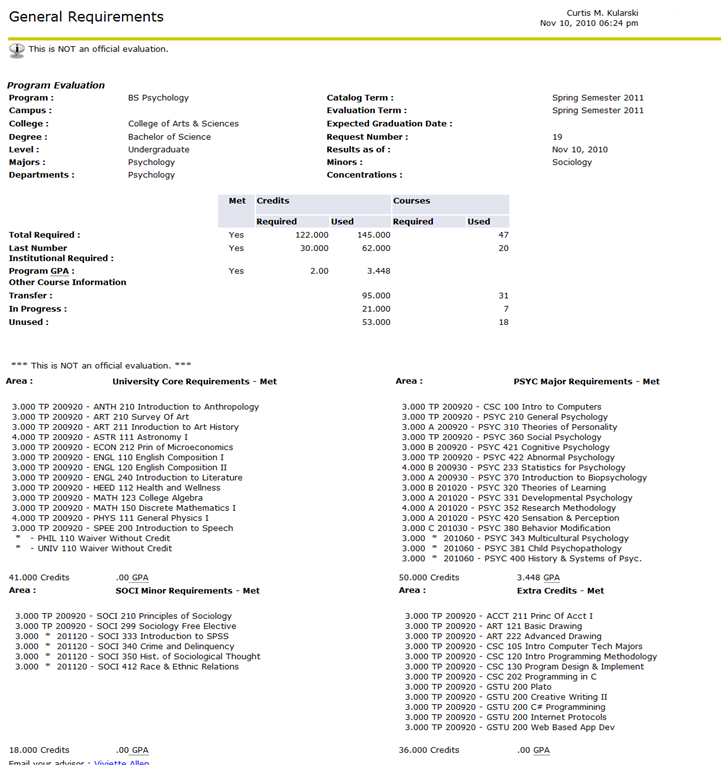
    CAPP degree audit now shows me clear to graduate in spring as of today.

  • Priorities for Spring 2011

    In considering course options for Spring, in the elective space, I have narrowed down my options quite a bit. At this point, my decision will be based on availability of courses.

    1st choice: SOCI 560, Advanced Sociological Theory, at Fayetteville. It is a graduate level course and will require me filling out paperwork and getting instructor, advisor, departmental and dean approval to enroll in. It would be a bit of a continuation of the theories chapter of my intro course and will compliment my other sociology courses, but at the same time be unique in that it will be somewhat writing intensive. I would love to take this course because for one I would like to know what I am getting myself into by becoming a graduate student, because it will look good to graduate schools and because I would like a bit of challenge. This course is dependent on approval.

    2nd choice: NOS 120, Linux/Unix, at CPCC. This course is one that I will take purely for fun. It does apply to my Computer Programming curriculum at CPCC, but that has nothing to do with why I want to take it. I want to learn more about Unix, since it is sort of a mystery to me. I can manage to install and use Ubuntu without much problem, but it is very much a Linux distribution designed for grannys. I’m looking for a more serious Unix experience. This course is limited only by availability and the fact that I can’t register until the 12th of November – after 4 other groups have registered before me. Currently 13 seats remain.

    3rd choice: CSC 234, Advanced C++ Programming, at Wake Tech CC. I do not like the fact that for this course I would be adding another active institution to my list of schools, which would mean that the process of synchronizing transcripts between schools would get yet another level of complexity. The course would allow me to expand my programming skills on another programming language and I suspect I would find the course to be quite rewarding. At this time I am registered for this course, but the course would be dropped if one of the above choices became available.

    4th choice: ART 114, Art History Survey I, at Gaston. I have attempted this course before, but found myself to be not able to get into the material at the time. I am still hesitant on the idea of giving up on Fine Arts, so this course would perhaps give me a little guidance. I am not very familiar with art history in terms of things before modern art, this course would fill in a few of those blanks for me. If I select this option it has the added benefit of applying credit to my AFA degree. This course is also dependent only on availability, but I should be in the first group to register, which should limit the scarcity. Since choice #3 is already registered, this one will require some thought before I can select it.
  • GRE Vocabulary

    I have been spending a little time working on preparing for the GRE by learning its vocabulary. I am having a little difficulty with it because I have not really had to artificially expand my vocabulary in a while, usually words just come naturally to me, but these aren’t like that. I usually do pretty well with words when I can identify their root word, but these are words that don’t have the benefit of an identifiable root (words like ‘panegyric’, ‘skullduggery’ and ‘cacophonous’). The words that really fluster me are the short ones, like ‘agog’, which apparently means highly excited. I don’t see something like ‘agog’ and see excited, I look at it and I see something that seems more like a phrase to describe muddy water. I do wonder why we have so many words that mean nearly the same thing.

    I feel a bit like I’m back in 3rd grade again. I used to love working with words, and in some ways I suppose I still do, but I’m in a bit of a time crunch and I can’t just pick up one or two at a time and try to work with them. I suspect the best way for me to work through these words is to simply start using them. That seems to be the only aegis against a horrible GRE score. I have nothing against learning the words at all, I’m just aghast that I won’t be able to. I would very much like to learn these words in such a way that they coalesce into my normal vocabulary so that I may in general be better at communication. Presently, I am trying to recall all of those little techniques that I used to use to try to memorize new words and to expand my vocabulary.

    If anyone has any tips on how to learn words, I’m listening.

  • Waiver of NOS 110

    In my list of potential elective course, I listed a course, NOS 120 (“Linux/Unix Single User”). That course had a pre-requisite, NOS 110.

    NOS  110 – Operating System Concepts
    This course introduces students to a broad range of operating system concepts, including installation and maintenance. Emphasis is place on operating system concepts, management, maintenance, and resources required. Upon completion of this course, students will have an understanding of OS concepts, installation, management, maintenance, using a variety of operating systems.

    It would seem that my academic record is now sufficient to get me out of these basic courses when necessary. The division dean has given me permission to override that pre-requisite so that I may take on the challenges of Unix.

  • Am I lacking civility?

    My message to Dr. Montoya:

    Dr. Montoya,
    I think there is a problem with Test 2. The test does not present in order. The questions are jumbled up, which makes deciphering your question groups nearly impossible.
    Curtis M. Kularski
    PSYC 443 D1

    His reply:

    Hi Curtis; Thank you for writing. I just checked the test and I’m not sure what do you mean by "jumbled up". The test seems in order. Please, try gain.

    In addition, I would appreciate some civility in your communications. Your tone is not very professional. I want to refer you to our netiquette guidelines which you can find here: http://www.albion.com/netiquette/corerules.html.  Further communications with inappropriate tone will be referred to our Department Chairman.

    Take care

    Daniel Montoya Ph.D.


    Where did I go wrong? Am I missing something obvious?

  • NCCCS Descriptions for Elective Options

    I’m still seeking that perfect course for my final 3 credit hours for Spring 2011 (and likely my final 3 credit hours earned as an undergraduate). This course does not have to count toward any program, or even be transferable back to another school. The course just has to be interesting and fun to me. I am trying to stay at least a little out of the humanities as I will be taking 12 hours of Sociology at Fayetteville. I have selected several courses that are offered during the semester is forms that are accessible to me at all of the colleges across the state and retrieved the appropriate course descriptions for the courses. Here are the finalists:

    ART 114 Art History 1
      This course covers the development of art forms from ancient times to the Renaissance. Emphasis is placed on content, terminology, design, and style. Upon completion, students should be able to demonstrate an historical understanding of art as a product reflective of human social development.
    ART 171 Computer Art 1
      This course introduces the use of the computer as a tool for solving visual problems. Emphasis is placed on fundamentals of computer literacy and design through bit-mapped image manipulation. Upon completion, students should be able to demonstrate an understanding of paint programs, printers, and scanners to capture, manipulate, and output images.
    ART 260 Photography Appreciation
      This course introduces the origins and historical development of photography. Emphasis is placed on the study of composition and history of photography as an art form. Upon completion, students should be able to recognize and produce, using color transparencies, properly exposed, well-composed photographs.
    ART 265 Digital Photography II
      This course provides exploration of the concepts and processes of photo manipulation through complex composite images, special effects, color balancing and image/text integration. Emphasis is placed on creating a personal vision and style. Upon completion, students should be able to produce well-executed images using a variety of photographic and photo manipulative approaches.
    BIO 168 Anatomy and Physiology I
      This course provides a comprehensive study of the anatomy and physiology of the human body. Topics include body organization, homeostasis, cytology, histology, and the integumentary, skeletal, muscular, and nervous systems and special senses. Upon completion, students should be able to demonstrate an in-depth understanding of principles of anatomy and physiology and their interrelationships.
    CHM 131 Introduction to Chemistry
      This course introduces the fundamental concepts of inorganic chemistry. Topics include measurement, matter and energy, atomic and molecular structure, nuclear chemistry, stoichiometry, chemical formulas and reactions, chemical bonding, gas laws, solutions, and acids and bases. Upon completion, students should be able to demonstrate a basic understanding of chemistry as it applies to other fields.
    CIS 245 Operating System – Multi-User (Linux)
      This course includes operating systems concepts for multi-user systems. Topics include hardware management, file and memory management, system configuration/optimization, and utilities. Upon completion, students should be able to perform operating system functions in a multi-user environment. Operating system utilized: Linux, adaptable to Unix
    CSC 234 Advanced C++ Programming
      This course is a continuation of CSC 134 using the C++ programming language with standard programming principles. Emphasis is placed on advanced arrays/tables, file management/processing techniques, data structures, sub-programs, interactive processing, sort/merge routines, and libraries. Upon completion, students should be able to design, code, test, debug and document programming solutions.
    GEL 120 Physical Geology
      This course provides a study of the structure and composition of the earth’s crust. Emphasis is placed on weathering, erosional and depositional processes, mountain building forces, rocks and minerals, and structural changes. Upon completion, students should be able to explain the structure, composition, and formation of the earth’s crust.
    MAT 263 Calculus II
      This course provides a rigorous treatment of integration and is the second calculus course in a three-course sequence. Topics include applications of definite integrals, techniques of integration, indeterminate forms, improper integrals, infinite series, conic sections, parametric equations, polar coordinates, and differential equations. Upon completion, students should be able to use integration and approximation techniques to solve application problems.
    NOS 120 Linux/UNIX Single User
     

    This course develops the necessary skills for students to develop both GUI and command line skills for using and customizing a Linux workstation. Topics include Linux file system and access permissions, GNOME Interface, VI editor, X Window System expression pattern matching, I/O redirection, network and printing utilities. Upon completion, students should be able to customize and use Linux systems for command line requirements and desktop productivity roles.