As if I weren’t doing enough this semester already I have decided to take on the task of learning about Machine Learning. The course is offered by a Stanford University associate professor of computer science, Andrew Ng (see http://ml-class.org if you are interested). Originally I was interested in this course simply because I’m a nerd and I like classes like that. Now I am sticking with the course and taking it more seriously because of my recent admission to the cognitive science program at UNC Charlotte. The course should provide me with direction for potential research as well as give me a bit of an edge when it comes to introductory cognitive science concepts and eventually machine learning courses in the program. So far I have only completed the introductory section of the class, but find myself drawn to the material and interested in a very serious way. Beyond the material of the course I am enjoying the way in which the course is being taught. It is designed the way I always thought that distance education courses should be, video lectures with written points, all broken down into easy to handle units. When I say broken into units, I mean each topic is given its own video, with a quiz question to confirm material understanding). If the course were designed any other way I might not be able to convince myself to integrate it into my schedule, but because so far the lectures are no longer than 15 minutes in length, I can easily work on the material any time and feel like I can get something accomplished before I have to be distracted for something else. The most interesting thing about the course design is that it is specific to the course. There is no course management software to get in the way, it IS the course itself. The difference between this course and something like Moodle is that it is cleaner, only what needs to be there is there and there are no distractions from other courses that a student may have (such a thing would not be there in this situation anyway). Why can other online courses not be like this? It isn’t so very different from any other type of course that would ordinarily be offered online.
Category: Academic
-
Constructing Hegemonic Masculinity
[Cross Post: http://www.masculineimagery.net/?p=15]
In my current reading for sociology of masculinity (tutorial) I have run across some interesting and some disturbing conceptions of what drives masculinity. In the article I was focusing on tonight the author (Sharon Bird) conceived of a masculinity formed by three basic principles:
- Emotional distance
- Competitiveness
- Sexual objectification of women
I find the concept somewhat disturbing, but I cannot deny it either. It seems as though the current baseline of hegemonic masculinity is still founded on those ideas. I have come to accept item 2 about masculinity, but I cannot believe that 1 and 3 still hold that firmly in practice for most men. The problem with hegemonic masculinity is in the separation of the gender role and the gender identity. In hegemonic masculinity the gender role is everything that is conceived of and accepted as “masculinity” in societal norms. Gender identity on the other hand is the components of masculinity that a male decides to use, and also some components that may not reside in the standards of masculinity. The identity often contains an acknowledgement of the role and what is required to maintain a masculine identity in public. Hegemonic masculinity in the gender role side is static and self-protecting (through fag discourse and other social sanctions). This limits the amount of influence that anyone can have on it. While gender identity is always evolving, gender role is what it always has been.
One of the key components of hegemonic masculinity is a clear separation of men and women. It is what allows men to define themselves. The emotional distance is designed to protect the male from appearing weak and also provides a certain amount of control in social situations. The competitiveness functions as a way of establishing a hierarchy of distinction between men. An individual male must define himself and defend his right to be a male by being “better” then someone else. This trait of distinction is always what leads to sexual objectification of women. Men prove their significance and power by proving that women are inferior. In sexually objectifying women this boundary is established.
If I were to approach the topic from a Freudian perspective I would say that men who subscribe to hegemonic roles have developed a system of ego defense and are dependent on their own status and distinctiveness in the world for emotional stability. From a conflict (Marxist) perspective I would see it as the normal way of the world. The Marxist perspective is the most optimistic, since it provides the hope that the women and the subordinated men will create a unified social presence and overthrow the influence of the hegemonic standard.
[thought to be continued]
-
SOCY 6895 Paper Outline
brought to you by LivescribeThis project is starting to come together, mentally at least. There are still so many articles to read and so many things to review. There will also be a bit of concluding research. I am personally happy that I managed to get this outline out. It is rough and will be updated frequently, but I feel like its putting things in the right direction and putting things in a visual space that I can comprehend, now all I have to do is fill in the blanks. -
Fall 2011 Semester Papers
Tutorial in Sociology [SOCY 6895] – Final paper only. Topic Sociology of Masculinity. The specifics are not yet determined, but the paper will focus on the Western conception of masculinity in its hegemonic form and in alternative forms.
Introduction to Lesbian and Gay Studies [WGST 2050] – 3 papers (2 req, 1 EC). Topics selected from the major course sections.
Paper 1 (History), Declassification of Homosexuality from the Diagnostic and Statistical Manual of Mental Disorders.
Paper 2 (Sociopolitical), Evolution of Interaction Between Homosexuality and Western Religions [tentative]
Paper 3 (Indentity), Gay Identity vs. “Disappearance” [tentative]Transnational Feminism [WGST 5050] – 1 paper. Topic is selected from topics covered in course readings. I have done little to no planning on the paper as of yet, but I’m focusing on the area of a critical analysis of transnational feminism vs. global feminism.
Theoretical Approaches to Sexuality [WGST 6601] – 1 paper. Topic is open ended, but should be based on the core topics on the syllabus. I have selected to focus on the social construction of non-normative sexual behaviors.
-
Why Masculine Studies?
[Cross Post with: http://www.masculineimagery.net/?p=10]
Why did I choose to focus on masculine studies, when it seems that feminist theory is where everything is?
The simple answer is because I feel that masculinity is where the social problems originated. There are social difficulties because of hegemonic masculinity. This is the problem for non-whites in western culture, it is the problem for non-heterosexuals and it is the problem for women. It is my belief that as long as masculinity holds the power and a certain type of masculinity is defining culture, then there can be no liberation and no equality. Society is crippled and controlled by a gender that makes up a lot less than 50% of the population. Assuming that there were 50% men in the United States (there isn’t, its closer to 55% women, 45% men I believe, but I don’t have the exact numbers at the moment), we must remove those that are non-white, and those who identify as something other than heterosexual to find out final number. In those remaining after taking those numbers away, only about 1/3 of them probably have the financial resources to have “power” in society, and the other 2/3 believe that just because they fit the hegemonic standard they are somehow attached to that power and continue to support the mission of those who do have power. The issues lie in the masculine ego, and in the social institutions that value having a penis.
Another concept I have considered is that one day men will no longer rule the Earth. Women are slowly beginning to realize that there is someone behind the curtain pulling the strings and that men are not the majority and have done nothing to deserve the power, and the world is slowly changing. Once men are no longer in a position of power I feel that the construct of masculinity may be severely damaged. I personally believe that being a male who holds a masculine identity is something that is quite special, and do not wish to see men (collectively) reduced to just another
“human”“person” in a homogeneous pool of homo sapiens. I feel that masculinity is in need of a major revitalization to an establishment that does not exist based on power, but on a certain solidarity and sense of shared honor. Those traits cannot be held while others are being oppressed to support the masculine cause.Finally, feminist theory is great in concept. Feminist theory proposed equality for all genders and sexes. It is an honorable goal, but current theorists in the field are lacking a key factor in making that happen, men. Elizabeth Grosz has become my favorite feminist to pick on, just because she is so far out there with some of her writing. She believes that certain concepts of physics (mostly our understanding of mater and time) need to be reconsidered simply because they were created by men. There are implications made that because the theories were established by men, they must in some way be flawed and designed to oppress women. I do admit however, that there are others in the field that seem to be for the equality of everyone and seem to be focused erasing social boundaries. Unfortunately, those individuals tend to be more on the side of sexuality studies, and no one in this society (outside academics) really takes them seriously, society just isn’t ready for it yet.
I am in masculine studies because I am a man, whether by my biological components or my socially presented gender. I do not wish to discriminate against women, homosexuals or any other group. I am curious about how the masculine identity was formed and how society molds and manipulates it. I am a male and I am proud of it.
-
SOCY 6895: Basic Thoughts for Constructing Project
I have been keeping up my notes for my project in my notebook and not in anything digital, so I can add things to my notes as soon as I have a thought. I had some good ideas on Monday in Transnational Feminism and tonight in Theoretical Approaches to Sexuality. I feel like the project is coming together a bit and I am beginning to understand the direction I am wanting to go regarding it. -
I’m Out
Today was pretty interesting in Theoretical Approaches to Sexuality. About half way through the class time Dr. Stephenson conducted a bit of a “class introduction”. We went through the names of everyone and why they were in the class on the first day of class, but today instead we had a group coming out. I must admit that the idea made me a little uncomfortable at first. The general idea was that we were to go around the room and everyone was supposed to announce their sexual identity. Having never been much for the idea of labels or even with being particular open. I don’t have a need to lie about my sexuality, but I’ve never really felt the need to announce it either.
Anyway, we went around the room and expressed how we sexually identify ourselves. After we were all basically sworn to uphold the idea that whatever was said in the room was entirely confidential, Dr. Stephenson started. Unfortunately for me, I was the one sitting closest to Dr. Stephenson, so I had to go 2nd, being the first student to announce my sexuality. I was a little uncomfortable at first, announcing “I’m a gay male” just seemed awkward, but the more I spoke, the more I saw that my classmates were receptive to me and what I was saying about my personal life.
It was very interesting being directly asked in an academic setting to reveal something like that. In some ways it seems like it was inappropriate for her to ask us to do that, but then it also seems important. The class is Theoretical Approaches to Sexuality, so it is a relevant piece of information for such a discussion-based class. While at the time I couldn’t see the relevance, it is starting to make sense to me. By having us this early on, the week before we begin diving into actual theories of sexuality, there is a slight awkwardness released and an openness established that I am thinking may help the class be more productive by being able to freely express our opinions and perspectives on sexuality. I know that I feel that I have nothing to hide anymore in that class.
-
Adapting to Critical Theory
I am two weeks into my “theoretical approaches to sexuality” course, and I find myself troubled by the base layer of theory being used in the course. Critical Theory is central to the course’s material. To me, Critical Theory is a little too much like metaphysics for the social sciences. I accept the basic premise that there can be no such thing as academic Truth and that there is only a culturally and temporality relevant perception of Truth. From what I understand of the history of the theory itself, it was created out of squabbling between academic departments over who is “right”. I find the fact that it required the creation of post-modern critical theory to allow interdisciplinary studies to come into existence to be absolutely disgusting. Perhaps I am just a bid jaded by the fact that I come from an academic background of philosophy, art, computer science, psychology and sociology. Art, computer science and the collective remainder do not interact or overlap in their areas of study, so perhaps I didn’t notice from that. As for philosophy, psychology and sociology, I find the disciplines to interact peacefully and not have many conflicts over teachings. There is the concern of “Social Psychology” and “Psychological Sociology” (sometimes “Social Behavior”), but that is merely a minor issue of what to focus on.
The key component of post-modern critical theory seems to be the rejection of a unitary theory of the whole. I am totally OK with that aspect, I think we (collective academic we) can all agree that there is no single theory that covers everything or that is acceptable to everyone. I also accept that any “truth” in academics is merely a consensus of enough heads in the subject area. My problems with critical theory begin with the fact that we loose valuable information as a society or culture as a result of abandoning those Truths of consensus. I believe that throwing out all existing theories as a result of their non-compliance with the anti-bias rules of postmodernism is irresponsible. Our current “Knowledge” and understanding has been created from the movements that began during the Enlightenment. While it has been a long time since the beginning of the age of reason, those values are still in use and are still important to our understanding of the world around us. Abandoning those ideas pre-maturely seems like something that could throw society into another dark age. One of the key questions I have seen in postmodernist writings is “how do we write about the world now?”. There have been plenty of writings on the topic, but it is mostly critical theory being used to analyze itself, essentially getting us nowhere. I do believe that human modes of inquiry must evolve, but I do not feel that we have evolved enough academically or even reasonably to begin to move toward the type of intellectual inquiry that critical theory asks us to use.
Still, the class is being taught using that method of inquiry and I must go along with it. I shall keep an open mind as I always do in an academic environment. I just feel that time could be better spent exploring the depths of sexuality and not just establishing this new field of inquiry. As pointed out by Dr. Jane Flax, there are numerous modes of inquiry already in existence that can be used to compliment each other to develop a tangible understanding of sexuality and gender issues.
-
Settling in to Graduate School
I have never been indecisive about my class schedule until this semester. Even as a freshman my class schedule seemed to be pretty well guided, but this semester, things have changed so much from my initial registration.
Theoretical Approaches to Sexuality and Introduction to Lesbian and Gay Studies has been a constant on my schedule. Those two have not changed at all.
The other spaces have shifted around. I went from Philosophy of Social Justice and Research Methods to Counseling Ethics and Tutorial in Sociology. Finally I am in Tutorial in Sociology and Transnational Feminism. Course descriptions are provided below.
For the Tutorial in Sociology I am working on the topic of “masculinity”. I started off being a little nervous about the tutorial course because initially I could not get any information about the course from the assigned instructor and then I found documents that contradicted what I was being told. I am becoming a little more relaxed with it now that I have met the instructor that I am doing the course with. I now know what is expected and know that I can do it.
Initially I started this semester knowing that I would have 1 class with Chris, Lesbian and Gay Studies. It is a class that is of interest to both of us, for obvious reasons. At least for me it is sort of like having an overview class of a missing part of my cultural history, as well as giving some insight into the movements for social justice. Now, after a week of classes, Chris found displeasure in one of his other courses, and is joining me in Transnational Feminism (it is a cross-listed grad/undergrad course). I am looking forward to having someone to discuss the course with, but I’m not looking forward to the fact that when he writes his final paper, it doesn’t have to be nearly as long as my final paper.
Theoretical Approaches to Sexuality [WGST6601]
Katherine S. Stephenson
An interdisciplinary examination of the history of sexuality and contemporary theories of sexuality and the body. Topics covered include historical aspects of sexuality; representations of sexuality; politics of sexuality; critiques of psycho-analytic approaches to sexuality; feminist engagement with biological constructions of sexuality; and queer theory. — 3 hoursActive
Introduction to Lesbian and Gay Studies [WGST2050]
Theresa L. Rhodes
An overview of gay, lesbian, bisexual and transgender issues from historical, sociological, psychological, and cultural perspectives. This introductory course examines a broad range of contemporary gay, lesbian, bisexual and transgender issues in various contexts including bio-medical, sociological, political, racial and sexual. The purpose of the course is to introduce the students to key concepts, terms, and issues related to lesbian, gay, bisexual, and transgender people. Additionally, the class will include historical influences over the past fifty years that have shaped the present day culture within the LGBT communities. — 3 hoursActive
Tutorial in Sociology [SOCY6895]
Stephanie M. Smith
Prerequisite: permission of instructor. Directed reading and/or research; development of expertise in substantive area. May be repeated for credit. (Fall, Spring, Summer) — 3 hoursActive
Transnational Feminism [WGST5050]
Robin James
Transnational feminisms address questions of gender and sexuality as they pertain to or emerge in contexts that cross, transgress, and problematize “national” borders and the idea of the “nation” itself. It is a discipline that examines how women’s lives, and the functioning of gender and sexuality, shape and are shaped by “globalization.” While this “globalization” is often the “invisible hand” of a neocolonial, neoliberal, Eurocentric capitalist hegemony, it also includes bottom-up feminist, queer, and postcolonial practices that resist and subvert this hegemony. Transnational feminism both makes this invisible hand visible, and gives it a kick in its erstwhile ass. In contrast to “global” liberal feminisms, which ultimately fail to de-center Western notions of gender, sexuality, politics, etc., transnational feminisms examine the intersections of “local” knowledges, practices, and values, with this more “global” Western hegemony. Transnational feminisms are attentive to the heterogeneity of women and queers both across and within nations. — 3 hoursActive
-
Textbooks for the Semester
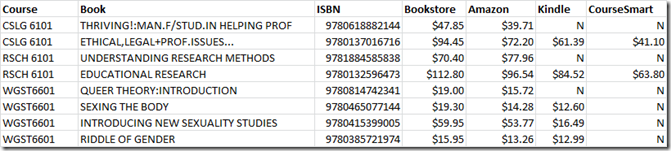
I had gotten very used to having the option of renting textbooks at Fayetteville. It was a very nice system. I pay a flat fee every semester for my texts and they are shipped to me. Now that I am fully back at UNC-Charlotte I am reminded of the horrors of buying textbooks. There seem like so many options and there are so many logistics to consider when buying textbooks.
My original goal for the semester was to buy only digital books, from either the Kindle store, or from CourseSmart. At least three of the required texts for my courses are not available in either format. Luckily, I will likely only keep either CSLG or RSCH 6101, but not both, so that does make it a little easier, but still, that’s 2 physical books to keep up with in addition to my laptop and other materials that I need in my bag (such as notebooks, since most of my classes are physical). On the positive side, there is a course that doesn’t have any textbooks and another course for which I have the option of selecting my own textbooks. Also on a positive note, my textbooks for all courses requiring them will still be less than $275, which is far less than the $400 I became accustomed to spending when I was an undergraduate at UNC-Charlotte.
