Category: Academic

  • Fall 2011 Papers

    My papers for the Fall 2011 semester are now released. All papers are turned in to their respective instructors.  You may retrieve my papers for reading by clicking on the PDF file of each document below.

    Changes in the Classification of Homosexual Behavior
    Introduction to Lesbian and Gay Studies (WGST 2050)

    image
    Absent Masculinity in Feminist Discourse on Sex Work
    Transnational Feminism (WGST 5050)

    image

    History of Queer Symbology
    Introduction to Gay and Lesbian Studies (WGST 2050)

    image
     
    Social Construction of Sadomasochism and Fetishism
    Theoretical Approaches to Sexuality (WGST 6601)

    image

    Gay Invisibility vs. Gay Identity
    Introduction to Gay and Lesbian Studies (WGST 2050)

    image
     
    Sociology of Masculinity: An Overview
    Tutorial in Sociology: Masculinity (SOCY 6895)
    image

    STATISTICS: 20,761 total words. 68 pages. Stats file.


    [This is an update to post: https://cmkularski.net/2011/12/update-on-fall-2011-papers-3/]

  • Update on Fall 2011 Papers (3)

    [This is an update to post: https://cmkularski.net/2011/11/update-on-fall-2011-papers2 ]

    Course # Paper Topic Pages Req. Status
    Tutorial in Sociology SOCY 6895 Sociology of Masculinity 15-20 IP:  12 pages
    LGBT Studies WGST 2050 Declassification of Homosexuality from the Diagnostic and Statistical Manual of Mental Disorders 2-4 Graded: 100%
    LGBT Studies WGST 2050 History of Queer Symbology 2-4 Graded: 100%
    LGBT Studies WGST 2050 ? 2-4 ?
    Transnational Feminism WGST 5050 Absent Masculinity in Feminist Discourse on Sex Work 15-20 Complete; Submitted
    Theoretical Approaches to Sexuality WGST 6601 Social Construction of Sadomasochism and Fetishism 20 Complete: 21 pages
    In Review
    — — Statement of Purpose for Master of Arts in Clinical Mental Health Counseling Admission 2 Complete
    — — Statement of Purpose for Master of Arts in Sociology Admission 2 IP: Draft 1

    Everything is done except for some basic stuff.

    My tutorial paper is a little behind where I wanted it. I wanted to have this paper finished by Thursday, but there was no rational way to do it and keep the other papers on time. It is coming along nicely, even if I don’t “tell a story” with it very well.

    My final paper for WGST 2050 is not complete, or even started. I scrapped my previous topic, and since it is an extra credit paper, it may or may not happen, depending on available time.

    Transnational Feminism is complete. The paper has been submitted as a 15 page paper. It isn’t a wonderful paper and I’m not really sure that my topic is coherent, but I have done the best that I can with it. My confidence in the paper is so low that I have not proof-read the paper for fear of wanting to rewrite it completely.

    The paper for Theoretical Approaches to Sexuality is beyond finished. I have passed the 20 page mark and probably still have 2 or 3 pages more to add as well as a little work on the structure of the paper and of course the last minute proof-reading.

  • Considering Protected Masculinity

    image

    The caption posted attached to this photo reads “Tilden Hooper stops by the Monte Carlo to take yet another shower before he heads off to the rodeo!”.

    The photo comes across as awkward and staged. Why? Because the guy is fully clothed. The image is obviously supposed to be a quick publicity photo to stick on Facebook, but why is this guy in the shower fully clothed, from hat to boots? I don’t expect to see him naked, as that violates certain cultural norms, but why is he so completely covered? Isn’t also the concept of showering while clothed a violation of cultural norms?

    My personal assessment of the photo leads me to believe that he is remaining clothed as a hyper-masculine display. To appear unclothed would be to expose a vulnerability, or to appear less masculine in a public situation. I think back on some of the discourse I’ve experienced in Transnational Feminism this semester and realize that there are components of culture that are completely contrary to itself. Culturally we look upon people who are veiled as being a threat, they have something to hide or must somehow mean us harm, but yet this individual in the photograph is exposing about the equivalent amount of flesh (by the time you consider the sunglasses), but yet we are supposed to accept this photograph as entirely normal? Men cover themselves in Western culture more than women do. I suppose its opposite to some other cultures in the world, perhaps women being veiled is a threat to our standards for the visibility of women for their objectification, but in our culture we protect men from the same type of objectification?

    This photograph would seem less awkward to me if he were standing outside the shower in a position ready to begin undressing, but by being in the shower area fully clothed the meaning of the photo changes. He is essentially veiled, showing a masculine modesty, which allows him to keep all of his masculine power or the illusion of power (belt buckle + hat + boots = status symbols).

    Now, for my artistic critique. Bathrooms and showers are very awkward places for photographs. A subject is expected to be somewhat vulnerable, but it is up to the photographer to paint the frame in such a way that the suggestion of objectification is limited. If I were setting up this photograph I may have had the guy outside the shower, hunched down to remove his boot while looking at the camera (engagement of the eyes limits objectification), or I would have perhaps made the photo with him in the shower with his shirt off, with a towel around his neck. The lower half of the body would be covered, but there would be adequate vulnerability to cut the awkwardness of the frame and add a value of humor to the frame. Alternatively, use the frame as it is, minus the sunglasses, and add running water. It becomes a critique of cultural expectations, while also calling into question the defense of masculinity through being so veiled. Also that framing would be humorous in content, which tends to break the feeling of exposure during a private act.

    Maybe I’ve been reading too much discourse of masculinity and thinking too much about Transnational Feminism, but this photo just popped out at me as being “wrong” (not morally, just artistically).

  • Application Submitted

    20111128-210448.jpg

    I have filed my application for admission to the Master of Arts in Counseling program. Now I get to wait nervously for the admissions panel ands graduate coordinator to do their work. If the application is in line with the type of candidate the program is looking for, then I should be invited to an interview in January and things proceed from there.

  • Update on Fall 2011 Papers (2)

    [This is an update to post: https://cmkularski.net/2011/10/update-on-fall-2011-papers/]

    Course # Paper Topic Pages Req. Status
    Tutorial in Sociology SOCY 6895 Sociology of Masculinity 20-30 IP:  4 pages
    LGBT Studies WGST 2050 Declassification of Homosexuality from the Diagnostic and Statistical Manual of Mental Disorders 2-4 Graded: 100%
    LGBT Studies WGST 2050 Evolution of Interaction Between Homosexuality and Western Religions 2-4 Topic Selected
    LGBT Studies WGST 2050 Gay Identity vs. “Disappearance” (EC) 2-4 Topic Selected
    Transnational Feminism WGST 5050

    Eroticization of Non-Western People in the Sex Tourism Industry

    15-20 Proposal Complete
    Theoretical Approaches to Sexuality WGST 6601 Social Construction of Sadomasochism and Fetishism 20 IP: 8 pages
    — — Statement of Purpose for Master of Arts in Clinical Mental Health Counseling Admission 2 IP: Draft 2
    — — Statement of Purpose for Master of Arts in Sociology Admission 2 IP: Draft 1

    Tutorial in Sociology – I haven’t made any progress since the last update, mostly just because I have a special period at the end of the semester set aside for working on the paper. I mostly have a structure, which I like. I’m going to have to review all of the materials that I selected for this course in the next few days to begin fleshing things out a little more.

    LGBT Studies – I have 2 more papers to write, including one coming up on Tuesday. I’m not very excited about the next paper because I don’t really know what to write about. These papers are simple, so I have to pick a really narrow topic to consider. I may use the topic about the interactions between homosexuality and western religion, or I might change it up, just depends on what I come up with that I want to work on over the weekend.

    Transnational Feminism – this has been a hard paper to get started on. I am uncomfortable with the course material and I am not sure I understand the course objective entirely. It reads as a survey course, so there isn’t a consistent theme to work from. I think my topic works, and I completed a 3 page proposal for the topic this evening. I should know soon if the topic is up to what is expected or not. I think my proposal reads awful at the moment, so I will fine tune it before I turn it in.

    Theoretical Approaches to Sexuality – I keep changing my topic title for, even though the actual concept hasn’t changed. I have amassed way too much information for the paper, so now I’m working on sorting through that as I try to articulate my argument and my background facts.

    Statements of Purpose – these are just nagging little things that I need to take care of. I have until December 1 on one of them, and March 1st on the other one. I have drafted both of them at least once, but it is really hard to take my enthusiasm for each of the areas of study and turn it into a clear statement that will articulate to an admissions panel what my interests are.

  • Event: Robin James–Personally Speaking

    For anyone with an interest in music, gender and/or race, I would recommend attending this event. Robin James is an absolutely brilliant philosopher and a very eloquent speaker.  See the flyer below for all of the details:

    image

    http://www.uncc.edu/spotlight/2011/robin-james
    http://library.uncc.edu/node/847
    http://clas.uncc.edu/Personally-Speaking/
    http://philosophy.uncc.edu/Faculty/robin-james.html
    http://www.its-her-factory.blogspot.com/

  • My Spring 2012 Schedule

    Introduction to Cognitive Science [ITCS6216]
    Mark Faust
    This course presents multiple perspectives on the study of intelligent systems. Broad coverage of such topics as philosophy of mind; human memory processes; reasoning and problem solving; artificial intelligence; language processing (human and machine); neural structures and processes and vision. Also includes is participation in the cognitive science seminar. — 3 hours

    Planned

    Principles of Human-Computer Interaction [ITIS6400]
    Celine E. Latulipe
    Prerequisite: Full graduate standing, or permission of department. This course will be an introduction to Human-computer Interaction practice and research. The course will include topics on the perceptual, cognitive, and social characteristics of people, as well as methods for learning more about people and their use of computing systems. We will cover the process of interface design, methods of design, and ways to evaluate and improve a design. The course will also highlight a number of current and cutting-edge research topics in Human- Computer Interaction. The course will be a balance of design, sociological/psychological, and information systems elements. — 3 hours

    Planned

    Queer Theory [WGST5050]
    Katherine S. Stephenson
    Introduction to key issues in Queer Theory, a field of studies that questions and redefines the identity politics of early Lesbian and Gay Studies. Queer Theory investigates the socially constructed nature of identity and sexuality and critiques normalizing ways of knowing and being. — 3 hours

    Planned

    Sociology of the Internet [SOCY4090]
    Stephanie M. Mari
    In this class, we will use major sociological perspectives to analyze how important elements of our “real lives” (and the essential functions of society) are increasingly taking place on the internet – a world wide web of linked sites and virtual spaces that extend the structures of established social institutions (such as mass media, government, and economy), yet also provide unique opportunities for interaction with individuals, cultures, and information. — 3 hours

    Planned

  • Spring 2012 Class Schedule Released

    CSLG 6150  Career Development & Cslg
    W 05:30 pm-08:15 pm
    Henry L. Harris (P) 01/09-05/01 DENNY 216
    MA Counseling
    CSLG 6160  Theories Chemical Dependence
    T 05:30 pm-08:15 pm
    Laura J. Veach (P) 01/09-05/01 COED 202
    MA Counseling
    PHIL 6350  Philosophy of Technology
    W 03:00 pm-05:45 pm
    Gordon D. Hull (P) 01/09-05/01 WINN 107
    None. Personal Interest
    PSYC 6216 / ITCS 6216  Intro to Cognitive Science
    TR 02:00 pm-03:15 pm
    Mark E. Faust (P) 01/09-05/01 CHHS 290
    GC Cognitive Science
    SOCY 6090  Race, Class, Gender, and Social Policy
    R 02:00 pm-04:45 pm
    Stephanie M. Smith (P) 01/09-05/01 FRET 480C
    GC Gender Studies

    ITCS 6114   Algorithm & Data Structures
    MW  02:00 pm-03:15 pm
    Richard M. Souvenir (P)         01/09-05/01         SMITH 301

    Pre-Req. ITCS 6153
    GC Cognitive Science
    ITIS 6400  Prin of Human Comp Interaction
    M 06:30 pm-09:15 pm
    Celine E. Latulipe (P) 01/09-05/01 WOODW 135
    GC Cognitive Science
    WGST 5050 Queer Theory
    W 05:30 pm-08:15 pm
    Katherine S. Stephenson (P) 01/09-05/01 COED 202
    GC Gender Studies
    WGST 6627 Feminist Theory and its Applications
    M 06:00 pm-08:45 pm
    Robin M. James (P) 01/09-05/01 SMITH 201
    GC Gender Studies

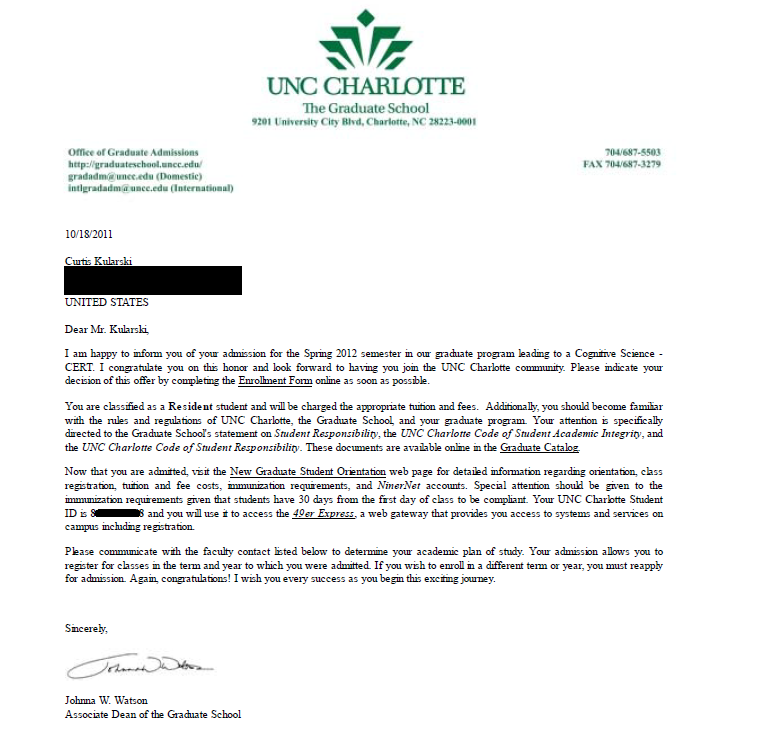
    The class schedule for spring has been released and I am back to having no clue what courses to take. Things seemed clearer before I was admitted to Cognitive Science, then it was simply 2 courses in my program and an elective. Now I have 2 programs to which I belong, and on top of that there are other courses that interest me.

    CSLG 6150 and 6160 are “open” classes in the Counseling department. They are courses in which I can “get my feet wet” (that phrase always makes me want to put on tall boots) with the department. I don’t love the material of either of the courses, but they are a good start in the department. but do I want to take courses in the department before I know if I got in?

    PHIL 6350 is a course that I saw and thought seemed interesting, but after reading its description I am uncertain about it, yet it remains in the list as a backup option.

    PSYC 6216 / ITCS 6216, this is the base introductory course for Cognitive Science. I could theoretically take either the PSYC or ITCS section, with basically the same work (if not identical), but I intend to make my selection of course symbolic of my direction in the program. Do I want to approach Cognitive Science from a psychological perspective, or do I want to take it from more of a technical direction? This is a tough decision for me, as I have an interest on both sides. I am considering setting up a sample program outline utilizing both and see which one seems more palatable.

    SOCY 6090 would be a course that focuses heavily on my topics of interest from gender studies in a sociological framework. I am a little concerned about the idea of this class because I am starting to feel a little burned out on this topic (it would be my 5th straight semester handing the topic)

    ITCS 6114 is a very technical course, focused on programming constructs. I typically enjoy courses like this, and I suppose I will again. This course is a pre-requisite to taking Neural Networks next fall. It doesn’t directly count to Cognitive Science, but if I want to take Neural networks, which does, I must take this course first. The title and description are pretty similar to an undergrad course that I had not very long ago, so I hope it won’t be very redundant.

    ITIS 6400 is a fascinating class. It touches on the ways in which computers attempt to perceive the same as humans, but also how humans utilize computers. This course covers sociological and psychological aspects of computer usage and interface design.

    WGST 5050, Queer Theory. This is one of the topics from other classes that I have become interested in. It goes beyond the traditional classification of homosexuals and defining the history and social significance of ‘queer’ culture. The theory itself seeks to step away from labels and to explore everything that is not the norm.

    WGST 6627, This is a core course in my program, or at least one option for it. I’m not sure I can handle another semester of feminism and feel like this may not be something I really want to take, but since it does count as a requirement I think it is at least worth considering.

    I have to decide what I’m taking by November 7th.