Category: Academic

  • Why penetrative intercourse?

    It is late. This may be terse.

    Why must gay guys engage in penetrative intercourse? Why does penetrative intercourse define what is gay? What does it bring to a relationship? To me it seems as though it is an attempt to appropriate heterosexual standards for relationships and sexuality. Is there not more to intimacy than penetrating your partner? Is there no other way to express passion? I have never looked at things this way, but in doing research for my queer theory paper I began thinking about the structure and gay identities portrayed in Latter Days. The scene where Christian and Aaron are happiest is immediately after they have had their first sexual encounter.

    To me the act of penetrating one’s partner seems primitive and quite unnecessary for achieving emotional intimacy with one’s partner. I am reminded of a scene in Star Trek: First Contact, Data and Picard are interacting physically with the Pheonix and Data asks of Picard “Does physical contact make it more real?”. Picard evades the question and tells him that it was a childhood fantasy.  I understand the need for physical contact, as I do enjoy it a lot, but somehow the intercourse portion just doesn’t make sense to me. Perhaps this is because I am a non-traditional gay. I am excited by emotional intimacy and more basic feelings and less by the idea of being penetrated or penetrating.

    For me personally there is a different aspect of masculinity at work that I am attracted to. I am less attracted to the power of the penis and more attracted to the power of the man. The phallus serves as a nice indicator to confirm biological pre-requisites for manhood, but it is not the only object of my interest.

    We are gay, can we not take a more evolved approach to sexuality that is less carnal?

    Now that blast of mental energy is out there, I will either integrate it into my current paper (on social control of gay identity) or I will carry it over and complete it in another semester as another paper.

  • Things Currently On My Mind

    imageimageimage

    These are by far the major things that are bugging me and occupying my thoughts. A final paper for Queer Theory, a final paper for Cognitive Science and a revised course proposal for my directed readings.

  • 4th Annual UNC Charlotte Philosophy Conference

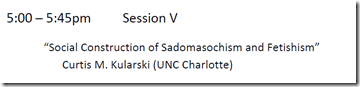
    All of the materials for the 4th Annual UNC Charlotte Philosophy Conference have been457487_387444597940791_186520684699851_1492721_1391053314_o released. This will be my first presentation at an academic conference. It is somewhat exciting to see my name and my paper title appear in the schedule for the event. I am also very nervous and unsure of myself. It helps that I know that I will be presenting in front of faculty and students that I am at least somewhat familiar with. I have been wrestling with myself over how to make the topic of my paper to an audience of philosophers, and I’m still not convinced that I have come up with the right answer, but they did select me, so there must be something relevant to them.

    I am generally not comfortable speaking in public, and especially not on topics that are involved in my paper, but I have been allowing myself to be more expressive in classes recently, so I’m hoping that will result in me managing to figure out how to present my topic in an approachable way.  I think my biggest fear is that I will finish my presentation in the time allocated (20-30 minutes) and then no one will have any questions and I will be standing there feeling like I have failed in presenting my paper in an accessible way.

    image

  • Visualizing Fall 2012

    image


    I accept that WGST 6800 is a guaranteed course on my schedule, as I have opted in to it (and am becoming the guinea pig for the directed readings course).

    Now, that leaves me with 9 hours to select. I can pick 3 courses from the blue and red groups.

  • Fall 2012 Registration

    image

    Next Monday I am due to register for classes, and I have idea what I want to take. The image above is my current planning guide as it appears in GITI. There are several classes that meet requirements in the Cognitive Science program, such as Linguistics, Intelligent Systems, Cognition and Philosophy of Mind. There are other courses that don’t apply to anything, such as Clinical Exercise Nutrition and Sex|Death|Religion, but would likely be fun to take. So far I have held myself to a policy of taking 9 hours that apply to something, and then giving myself the last 3 hours to play with. This year those last 3 hours were spent on undergrad courses, but for next year it seems like those will more likely be put toward hybrid classes.

    For Cognitive Science I am pretty sure I want to take Philosophy of Mind, but am a lot less certain between Linguistics, Intelligent Systems and Cognition. I think that Linguistics might be interesting, but perhaps a bit difficult. Cognition may also be interesting, but I’m not sure that I would enjoy it. The material seems a little dull and the instructor is not someone I have had positive experience with (but have never had a course with her before). Intelligent Systems is the odd-ball. I’m sure it would be fun, but I don’t know the instructor and I don’t really know what to expect or how deep the material would be. Between those classes, I just don’t know, and I have less than a week to figure it out.

    I have only one course left in the WGST program, but I do not know exactly how I plan to meet that requirement yet.  I could fill the space in with Language, Gender and Power this fall, but I am not sure that I wish to take 3 courses in the program with the same instructor. I am currently considering taking a course with a different instructor in the department next spring to meet the requirement.

    The Directed Reading course has become more certain at this point. Dr. James has agreed to do a project on Subculture Masculinities with me during the fall. I am very excited about the potential for that project and really want it to go well. Ironically, I will be the first person to ever take a directed readings course in my department. The concept of the course is so foreign that presently I am waiting for my graduate coordinator and department chair to decide what forms and process will be utilized for authorizing the course (required before a registration permit will be issued for it).

    I am not confident in my schedule for Monday, and I don’t presently know exactly what courses I will put on my initial schedule. As a grad student I have very little competition for courses, so there is a good chance that I will get into whatever courses I select.

  • Busy Week

    Just like last spring I have a  busy week coming up again. I have tons of stuff I have procrastinated on a little, and as a result I have to catch up on a lot for this week.

    • Monday – work with my group to build a poster for my Human-Computer Interaction class. Due Monday at 6:30pm.
    • Wednesday – complete work on my paper abstract and annotated bibliography for Queer Theory. In addition I have to prepare myself for a presentation of an interpretation of the work of Judith Butler for the class.
    • Thursday – three quizzes due for Cognitive Science
    • Weekend – Cognitive Science mid-term

    At some point between now and the 30th of March I have to prepare a presentation based on my paper from Theoretical Approaches to Sexuality for the UNC Charlotte Philosophy Conference.

    Written out my tasks do not seem to be that massive, but with all of them floating around in my head they feel like they are weighing me down heavily. Tomorrow morning I need to dive in to work on the poster, and then after that I MUST get to work on Butler for Queer Theory, and then Tuesday in my free time I need to work on my paper stuff. My paper components do not have to be great, just showing my progress on my paper.

  • Queer Theory Paper Proposal

    I have written my proposal for my paper in Queer Theory. Does this seem doable or am I going to make myself crazy going in theoretical circles trying to prove something that is just nuts?  

    Thesis: Social categories define behaviors and self-concept for individuals who are placed into those categories by social forces, regardless of personal desires or inconsistent components of personality.

    Individuals in Western society function with individual identities, compared to more collective identity systems embraced by some Eastern cultures. One of the important characteristics of being an individual is taking on categories in which one fits. Many disciplines utilize categories as a fundamental structure of their discourse. A prime example of this is sociology, which has gone so far as to categorize their categories, into ascribed and achieved categories. The duality is defined with the expectation that every type of category fit into one and exactly one status. Typically race, sex and age are considered to be ascribed characteristics, whereas gender, socioeconomic status and an assortment of other surface-level characteristics are determined to be achieved. Sexual orientation differs in its placement based on which theorist you ask.

    These categories define the individual in their social context. There are social expectations that an individual place themselves into a pre-existing category and assimilate fully with the traits of that category. These categories do not allow for a person to exist in multiple roles at the same time in a single category. An individual is restricted from existing simultaneously as male and female. When disparities with the rules of the categories exist, often a new label with be created. A person existing as both male and female would be labeled intersex, which carries a negative connotation in society and is generally regarded as an undesirable role in the system of sex. When there is social adaptation to allow for the inclusion of a previously excluded individual or group of individuals, there is typically a new label created, which is as restrictive as the previous set of labels.

    The pathologoization of same-sex desire allowed the heterosexuality and homosexuality binary to be created. When these identity categories were created, they provided a place for individuals who conformed to standards of opposite-sexed desire, and for same-sexed desire. An individual who exhibits desires for both sexes would have initially found themselves in a space between identities due to the binary thought process in Western society. In more recent times this identity space seems to be constructed as heterosexual and the Other in the eyes of dominant cultural groups. Gradually discourse has evolved to be more inclusive to difference, but labels and categories are still an integral part of identity formation.

    The confinement of labels inside of categories for traits that are as individual as gender expression and sexuality limit the ability of a person to express individuality or to develop a personality that is not restricted to conforming to an existing set of behaviors. For example, to be a gay male is to exist in a general category that is further defined as top, bottom or versatile. This indicates a refinement of identity based on the role and desired involvement in anal intercourse. In some cases, this is also used to define the gay male’s relationship to masculinity. This categorization does not leave open the possibility of a gay male identity that does not embrace anal intercourse as a standard way of sexual expression. By the social standards that exist clinically as well as in the gay subculture itself, a male who has same-sex attraction, but not a desire for penetrative intercourse does not fit into the category of being homosexual; however, the masculinity role of “fag” (Pascoe) may be met. In the same line of reasoning, the individual in question would also not meet the criteria for a heterosexual identity. Considering the structures in place in Western society, such an individual is only left with the category of asexual, which still does not seem to fit as there is still same-sex attraction.

    In my paper I would like to explore from a multitude of social perspectives the impact of categorical labeling on individuals who do not explicitly meet the criteria for inclusion into specific categories. My initial category of exploration is that of biological males that have same-sex attraction, but who do not participate in traditional methods of sexual expression. I would like to explore this type of non-conformity in relation to gender-perception, gender-expression and social involvement. If adequate resources are available I intend to expand my efforts beyond the scope of my initial inquiry and into a more general approach to the experiences of an undefined or in-between social category.

  • Can computers think?

    Can computers think? It seems like a simple question to answer, obviously they cannot, right? The question I pose in response to this is, can humans think? It seems obvious as well, humans are conscious and make decisions, therefore, humans think?

    Where do humans become special and distinct from the capabilities of computers? Human brains and computers have been compared to each other since the beginning of the notion of cognitive science for many purposes. In the beginning the idea was to make the comparison to make a more human computer, but now the comparison is more often used to simplify the understanding of the human brain by using the computer as an analogy. The real question here though is, how far off is the analogy? Are we discussing things that are really that dissimilar, or are we discussing essentially different implementations (organic vs. electronic) of the same system?

    When considered at the most basic level computers and the human brain have the same essential structures. Individual neurons are no sophisticated or interesting than a core of a processor, or a decision making circuit. There is no component of the human brain that is uniquely human. For the purposes of my analysis I will provide the following criteria that are considered to be components of human cognition that are “special”: self-awareness (often qualifier for sentience), emotion, adaptation, intentionality, and free will/sapience.

    • Self-awareness: humans are self-aware because we have the capacity to recognize that we exist and that certain tasks we take have an impact on our environment, or as a more common test, we see that what appears in a mirror is ourselves. Many robots have been programmed to pass this very test, and can recognize themselves with a great level of accuracy. More traditional computer-based intelligences can probably tell you all about themselves.
    • Emotion: Emotion is a really interesting concept for artificial intelligence because it is difficult to prove that it is real. Humans have universal emotional states that are somewhat determined by biology, but only the most basic emotions. This “innate” emotional state does not specify what stimuli triggers those responses outside of basic physical stimuli. Physical stimuli are unavoidable because of the fact that they are part of the design of the system, there is nothing special or magical about experiencing pain, as there is a sequence of electrical impulses and chemical reactions which generate that response as being pain. This stimuli is part of the system itself, and therefore is not a uniquely human property. It is possible to give a computer a simulated skin, and when the correct pressure inputs occur, or links are severed, the computer experiences a sensation which it can call “pain”. Other emotions, such as happiness, sadness, closeness, loss and others exist as social constructions. If we did not know that a guy getting kicked in his testicles was a humorous thing to watch based on social learning, we would not laugh. On the other hand, the guy being kicked responds to the occurrence as pain because of the fact that he experiences physical signals to cause that state of alert in the body.  All experiences of emotion are either by something that has been socially learned and conditioned, or through a physical stimulus. All of these things can be trained through programming on a computer. The problem at this point is that no electronic system has enough sensors or enough algorithms to approximate the entirety of human experience.
    • Adaptation: Humans adapt. Humans adapt due to certain aspects of biology. Adaptation is partially taught through example, and is partially a factor of evolution. If you cannot adapt, then you cannot survive, it is as simple as that. At this stage in computing, computers are like children, they run into obstacles and thus need assistance from a human. Ironically, it is mostly obstacles resulting from human involvement that limit the ability for computers to not function by themselves. Programmers make mistakes, users do things that are invalid. A cleanly written piece of software that is trained with adaptation skills through complex problem solving algorithms could adapt as well as or better than a human. The only problem is that first we need a better human. It is all about problem schemas and how easy it is to template a situation.
    • Intentionality: Intention can be related to purpose. Computers are perhaps better than this than humans. Computers are task oriented and are always moving toward a goal, whether it is a calculation or simply trying to interpret data. Computers need humans as a reason for their intentionality, which is in itself a limitation. Why do you do what you do? What drives you? The flaw for computers is that they lack a sense of accomplishment or any type of self-motivation. It is all a matter of programming. The modern human without the context of other humans would likely find themselves wandering aimlessly for something to do.
    • Free Will: The ability to decide what to do and when is an essential part of being human. Do computers do it? Not really, computers do what is prescribed by their programming. Humans are controlled by certain programming as well, mostly their priorities. Computers don’t have free will because they do not independently decide what to do or when. There is a question of determinism here most likely, but that’s a whole field of philosophy by itself. I think that it is possible to give a computer free will, and perhaps there is already the ability somewhat when it comes to computers intelligently making decisions, but that is still in the service of humans, not its own interests.
    • Creativity: What is creativity? This one is perhaps the hardest of the aspects to work toward because of the abstract nature and lack of understanding of the concept. Creativity is often an occurrence in the course of creating something. Ideas come from previous concepts, and inspirations that come from other places. Does anything truly original ever exist though, or are we all imitating each other, imitating the nature around us?

    The limitation to the computer as an intelligence at this point is that most of the research is focused on building machines to solve problems, or machines to handle specific tasks that humans do. There is very little work towards an artificial intelligence that is only an intelligence and not trying to solve something else too. There is no AI for the sake of a new intelligence.

    I would like to thank my friend Oscar for asking this question, which in turn allowed me to finally articulate my recent internal inquiry about the nature of computer consciousness.

  • My Next Academic Year

    image

    Above is my schedule for the next academic year as it stands (as of this morning). Fall 2012 has 15 hours assigned to it at the moment, but that will have to change to become a sane schedule (less than 12 hours). These schedules are currently reflective only of my presently enrolled programs (WGST and CogSci). The reason this post comes about is because this morning I learned of Dr. Croy planning to offer Philosophy of Mind in the Fall, and noticing when I added it that the list looked a little lengthy.

    Upon close examination of the schedule I find that first of all, Language, Gender and Power is likely to go away, since it no longer conforms to my planned course sequence for the WGST certificate. Next, Social Context of Mental Health may go away if I’m not admitted to sociology and my interest set changes at all (or I find a pet research interest for the semester). That leaves me with Intelligent Systems, Philosophy of Mind and Cognition, all of which apply to my certificate in Cognitive Science. Still, this is a pretty full semester, and if I am admitted to a Masters program, at least one of those courses will have to move.

    Spring 2013 is a little easier. If I’m admitted to sociology, Issues in Social Research is already on the schedule where it needs to be, but if not, it is still an interesting class I would like to take. Sexual Orientation Diversity in Clinical Practice is an odd course that I can only justify under the WGST certificate unless I’m eventually admitted to counseling. At the moment it is on the schedule as a space filler, but it is an area I am very interested in. If I’m ever involved in counseling or any type of social research involving mental health, I will want that class in my curriculum. Theoretical Approaches to Gender is a course that fulfills a major requirement (the final major requirement for me) for the WGST program, so I will likely hang on to that course.

    At the end of Spring 2013, my current enrolled programs will be complete, but I intend to by that point be enrolled in at least one masters level program.