Category: Academic

  • The Joy of Psychology

    This evening while preparing for a quiz in Theories of Personality I discovered (or brought to consciousness, depending upon if you are a Freudian or not) that I really like Psychology because it is a very modern thing. People who wrote the theories I am learning about are still alive (most of them) and the theories are still being tested and expanded. In completing a degree in mathematics, a person might only get to the things that were discovered up until around the 1500s or so, and for the average student, about 300AD is the newest material you will find in your curriculum. The theories of personality I am learning are new, some as recent as 2005, since I graduated from high school (and since I took my first psychology course). Even computer science doesn’t really see material that new. A new language sometimes, but the concepts are all fairly old. Graduate students get to learn the absolute newest, but undergrads are seldom that fortunate. There are worse topics for that I suppose, such as Art, where learning old stuff first and then new stuff later is encouraged and is the standard operating condition (you must learn how it was done the old way before you can learn the new way), and well… History.. they play a different game altogether.

    Aside from the more modern material, it is also kind of fun to explore something that is so versatile. Psychology spans the area of artificial intelligence, art development and so many other areas, especially as an extension of Cognitive Psychology. Cognitive psych proves that psychology is bridging between social science and actual science. As knowledge progresses, the bridge between social science and pure science will become wider.

    The biggest disadvantage to psychology is that there is very little history. In art you can call back to what has been done before and put it into cultural context and determine how we got from there to here, but in psychology, that just is not very easy, brains only last as long as people and once they are gone, so is the record of what was. All that remains is filtered notes and of course a few social relics (music for example).

  • Mid-term Grading

    I used to hate mid-term grades, but that was because they used to be such a negative thing. At all institutions I attended before Fayetteville State University, mid-term grades were assigned by instructors only when a student was doing poorly in a course, such as in the D or F range. FSU makes mid-term grading mandatory for all instructors for all students. I find this to be helpful on many aspects, including the as a booster to keep me motivated for finishing off a course strong, or in the case of situations where I may have a B at midterm, it helps to see the letter in the grade system, so I can see exactly how ugly of a grade it is so that I can be motivated enough to improve that grade, no matter what it takes.

    Grades are not a matter of fate, they show how hard we push ourselves academically.

  • Academic Encouragement

    This morning I was asked how I deal with the stress of academics and how I manage to keep things together. The answer I initially had was “I don’t know, I just do it”, but being somewhat distracted from my Cognitive Psychology reading (for the 2nd time in 2 days), I have taken some time to reevaluate the situation.

    When my due dates are falling upon me and I feel like there are 5 things due at the same time, therefore they are all the same priority, I take time to analyze which ones are really most important and run with them. If I find that I am lacking the motivation for that, then I will pick the one that is the most fun and start there. In the past I have taken that approach and fully expected it to be to the detriment of another assignment, but it ends up being that doing the fun assignment that I want to do helps get me in “academic mode” for the assignments that need to be done. Another thing I do is I will treat my assignment list as a mission (as it presently is), and I will dedicate a full day (or night, as needed) to doing course work and I will get everything done, as well as go back and do anything I may have missed (the occasional small assignment, like a discussion board post, that falls through the cracks).

    Instructors do not expect perfection, except in the math department. All instructors, except mathematicians, know that students are human and that it may not always be possible to do everything on time. If you do quality work consistently and you are on time, or ahead for most of the semester, instructors are willing to forgive a little slack, especially around the time of spring break, or towards the end of the semester. The key is to get everything done, and to do your best.

    If you have feelings like “I don’t like being a student” (personally occurs to me as thoughts of needing to drop a course), then that is the time to figure out why you are a student and also the time to spend some personal time with your course.

    Students who take online courses have to be self-motivated if they want to survive, especially in courses that are true asynchronous (no due dates, except end of the semester). This is especially true for freshmen who have not yet gotten down the pattern of things. I personally had 3 stages of preparation for college. First were the AP courses in which I had to learn college level work in a high school setting, as well as the AP exam, which is basically prep for the worse final exam you will ever have. Second was a set of two dry runs in the form of Early College and Dual-Enrollment in which I made the transition to college with 6 credit hours per semester for 2 semesters. I also had the “joy” of getting to experience the pain of a boring college course during a light semester. ANT 210 (General Anthropology) was a very boring and dry course, and I hated it, but I managed to make it through because of the light load. Those three experiences prepared me for diving into college. For those who have not had those experiences, the best thing to do is be very patient with the course material and take as much time as the material needs, not the perceived amount of time that you have.

    I think the general idea that the nervous student should take away from this is that you should stop worrying and just do, and don’t let yourself get stressed, it is counterproductive. During the freshman year a university class will shrink by as much as 20%, but for the next three years, there will usually be less than a 5% additional shrink in class size. Not all students will graduate with their “class”, actually, most won’t. Graduating in 4 years is not something many students do. Some students take courses during the summers and are ready to leave in 3 years, and some take things slower and will graduate in 4.5 years (4 years + 1 semester +/- summer sessions). Either way, shrinkage happens more in the freshman year than any other year, so it is especially important for first-time freshmen (FYI… “transfer freshman” = “transfer student screwed on transfer credit” in most cases) to find their own route to making their education work for them and fit their life. Undeclared students have things the hardest during the first year. In the 20% shrinkage group, between one-quarter and one-half of them are usually undeclared. Retention rates for undeclared students absolutely suck, that’s the reason for so many efforts by universities to reach their undeclareds and get them engaged. If you survive your freshman year, it is very likely you will graduate (unless there is some intervening emotional crisis, or you decide to take a scenic route to education).

    Hang in there, it isn’t as hard as it seems. There are rewards at the end of all of this, potentially even the reward of discovering who you are.


    *Statistics from this post are approximate and are from my memory of reading the statistics on the subject some time ago (last year). For up-to-date information from the most recent retention studies, please see National Survey of Student Engagement.
  • Picking a Theory

    I have finally selected a theory to use in my self-analysis paper for my Theories of Personality course. I have decided to go with Erik Erikson’s “Crisis” theory. The theory has phases that related to Freud’s psychosexual phases, but are more psychosocial phases. The phases are dependant upon a “central crisis” that must be completed, either by passing it (resolving it successfully) or failing it (resolving it negatively). I can draw some similarities between Erickson and Maslow’s “Hierarchy of Needs”, so I may end up using both of them. I like a lot of the aspects of Erikson’s theory, including that after a phase crisis has been failed, it is possible to have other experiences that reverse the outcome of the crisis. I feel that Erikson is a match for me because I can clearly identify phases I have passed and failed and things seem to line up with me pretty well.

    I still do not like the idea of self-analysis, but I suppose Freud did it, therefore, its good for all of us.

  • Disagreeing with Maslow

    Dr. Abraham Maslow’s key to human personality theory is a hierarchy of needs. Unfortunately, I find this key to be flawed and unlocks no information or understanding to the human personality. Upon first glance I recognized that the hierarchy did not really seem to need to be followed in order, but initially I blindly accepted that all “needs” lead to self-actualization and that all of the needs would need to be fulfilled before self-actualization could occur. Upon further thinking about what self-actualization is, I determined that Maslow probably intended for all component needs to add up to the final self-actualized step, but I find it to be not the case. Maslow argues that only 1% of people are self-actualized, but yet, I meet all of his requirements for self-actualization, without even fully clearing the “esteem” need. Seems a bit odd. Maslow’s work is not scientific and represents a gross attempt at a universal explanation for human behavior without him doing any actual work towards it. His theories are merely pulled out of the sky and written in a scholarly form to look good. Not a worthwhile theory set.

  • AAS in Computer Programming Substitutions

    Got an e-mail back from my Computer Programming advisor, quite unexpectedly (since it is Sunday evening). Apparently she felt my inquiry was quite important. Now I am worried though, she forwarded my questions to the chair of the department, who is also presently my C# instructor. I am a little uncomfortable with the questions going to him since I do not think he likes me. I also asked the questions quite hypothetically and with limited seriousness, since I do not feel compelled to complete the degree at this time, and do not have my evidence for waivers and substitutions prepared.

    I guess so much for hypothetical and “just asking”.

  • Uses of a Spreadsheet

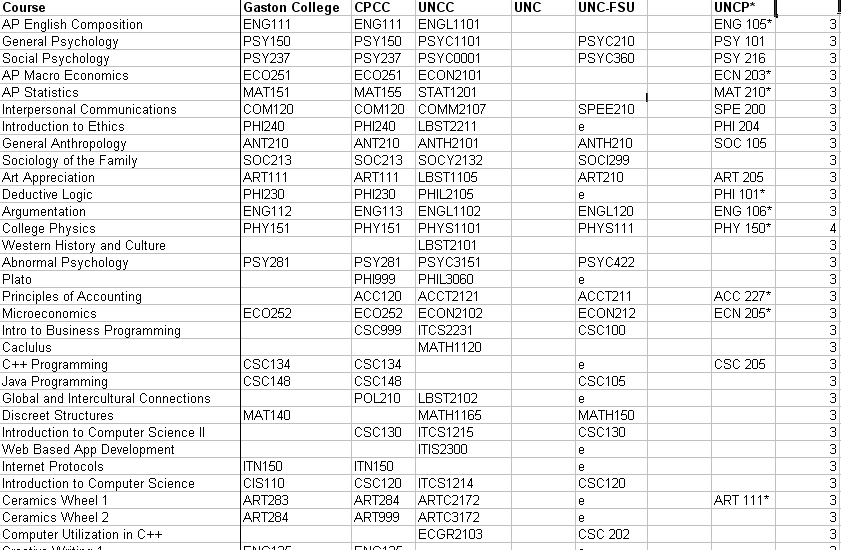
    untitled

    I don’t have a lot of use for spreadsheets anymore. Most things I do I keep in a MySQL database and have accessible from GITI or some other insane little utility, but for some reason I am maintaining my transfer equivalency matrix in a standard Excel spreadsheet (where maintaining is updating when I remember). So many things are inefficient about this thing, including, having no reference for what the origin institution is… but then again, that’s the beauty of this form,  they are just courses, with no institutional dependency, just what they are acknowledged as at each school. Perhaps it is time to move this into GITI.

    Key: e = Elective granted; * = projection (no credit yet awarded); [blank] =  confirmed non-transferability


    Geez! I must be bored, I never used to blog stupid shit like this.

  • Degree Audit (Associates)

    If I were to complete my deck of Associate degrees with the full assortment I would have to meet the following requirements:

    Associate of Fine Arts in Visual Art

    • 2D Design (ART 121)
    • 3D Design (ART 122)
    • Three studios from Photo 1 (261), Computer Art 1 (171), Painting (240), Jewelry (247), Print Making (231) or Sculpture (281)
    • Total of 15 SCH remaining

    Associate of Sciences

    • College Physics II (PHY-152)
    • Calculus II (MAT-175) and Calculus III (MAT-271)
    • College Transfer Success (ACA-122) WTF? I’m articulated bitch! 
    • Total of 13 SCH remaining

     Associate of Applied Sciences in Computer Programming

    • Introduction to Programming and Logic (CIS-115)
    • System Analysis and Design (CTS-285)
    • Computer Programming Capstone (CSC-289)
    • Database Concepts (DBA-110) ugh! can I substitute?
    • Operating System Concepts (NOS-110) see above
    • Security Concepts (SEC-110) ok, I assign root/admin too much
    • Network Concepts (NET-110) or Network Basics (NET-125) didn’t I do this in Network Engineering?
    • Information Systems Business Concepts (CTS-115)
    • Linux (NOS-120) or Windows (NOS-130) pretty sure I could exam out of it
    • Advanced C++ Programming (CSC-234) if my prayers are answered
    • Total of 30 SCH

    While the AFA and AAS in CP are equally useful, I am more likely to complete the AFA because there are too many redundant requirements in the Computer Programming Degree. If I completed the AS it would be after everything else was done and just for the fun of fucking with people.

  • Due Dates and Deadlines

    I should really learn to be more careful with how I handle due dates for things. Last night I was in a panic, trying to get my Cognitive Psychology paper done before midnight Sunday (Fed. 8th). The due date in GITI became the 8th because it was originally set for the 5th because of the self paced nature of Cognitive Psychology. In Cog, all of the assignments are due when the unit closes, in this case, I thought the unit closed on Feb 8, but it turns out that the new module opens on the 8th and the present module closes on the 12th, so I prepared my assignment about 4 days too early and was in a panic, and making plans around the assignment for no reason. I guess if I am going to deviate from my decided schedule in this course, I should probably check with the master schedule before making any new dates, oops. I worry that the problem could have gone reversed, calmly completing an assignment against an adjusted due date, only to find out that the assignment is overdue. I do not want that to happen, ever.

  • Memorizing a New Catalog

    I just set on the task of preparing my Summer 2009 “Advising Verification Form” for Fayetteville and came to a sad realization that I do not know all of the course numbers yet. I am used to registering or planning courses at an institution and having a working knowledge of the course numbers and being able to relate them to course titles, and in some cases, recitite the course descriptions.
    It has been so long since I have had to introduce myself to a new course catalog. It is really bothering me that I do not have a physical copy of the course catalog, which is usually the way I memorize course information. I am stuck flipping between tabs in FireFox to get course information.
    Maybe before I get my degree I will have the catalog memorized, at least for my departments (PSYC and CS).