Picking a Theory

I have finally selected a theory to use in my self-analysis paper for my Theories of Personality course. I have decided to go with Erik Erikson’s “Crisis” theory. The theory has phases that related to Freud’s psychosexual phases, but are more psychosocial phases. The phases are dependant upon a “central crisis” that must be completed, either by passing it (resolving it successfully) or failing it (resolving it negatively). I can draw some similarities between Erickson and Maslow’s “Hierarchy of Needs”, so I may end up using both of them. I like a lot of the aspects of Erikson’s theory, including that after a phase crisis has been failed, it is possible to have other experiences that reverse the outcome of the crisis. I feel that Erikson is a match for me because I can clearly identify phases I have passed and failed and things seem to line up with me pretty well.

I still do not like the idea of self-analysis, but I suppose Freud did it, therefore, its good for all of us.

A Few Thoughts On This Blog

As I mentioned in a previous post, there are things that do not get mentioned here, they are considered too “private” to share here, but yet I share them with people I know even less about than the primary target audience of this blog. I do not know a lot of people that do not already know about the more private aspects of my life, and anyone new will likely be temporary or will be informed soon enough. I am a very open person when it comes to expressing myself, and sometimes I self censor too much. There was a time I avoided mentioning that I am gay on this blog, but now, a simple Google search of this blog will reveal my sexuality rather quickly. What am I afraid of? Do I think a little kink and perhaps some emotion about it might run people off? There is a wide spectrum of searches that end up with people thrown at one page or another of this site, and honestly, I would much rather come across as myself, not some watered down filtered version of myself. Maybe my fear rests in the idea that no one will be freaked out by my freakyness?
Another topic that has come up for me is the layout of the blog, its a standard MT template with a few customizations, but mostly, its a MT template, and I don’t like that very much. I noticed the other day when looking through some blogger blogs that almost everyone there uses the same template (the black one) and if I were to search a little, I’m sure I would find an ass-load of blogs that use the same style. I don’t like being so unoriginal. Perhaps a task for another day will be to work on giving my blog some personality, other than in text. I have been using more images lately, but that does not seem to be enough to make the blog seem alive.

One-Thousand Blog Posts

As of this moment there are 1006 blog posts residing on my blog engine (Moveable Type) that I have written. I have made a total of 6 cross-posted posts in my blogging history, so this brings me to my present total of 1000 unique blog posts. Over 850 of those posts belong to this blog. I feel a bit unaccomplished at this point as this blog has been in existence of close to 5 years. I guess I thought I would have been a little farther along by now.
In some ways the total number of posts is irrelevant, but the distribution of posts is more descriptive of my life. Lately I have had a somewhat higher number of posts per month than I have had for years in the past. When I am active as a person, I am active as a blogger. When I do nothing as a blogger, I am a depressed person.
Maybe before I reach my next 1000 posts I will go through my blogs and properly tag and categorize each and every entry. It is quite a bit of work, so it will likely take a while.

Disagreeing with Maslow

Dr. Abraham Maslow’s key to human personality theory is a hierarchy of needs. Unfortunately, I find this key to be flawed and unlocks no information or understanding to the human personality. Upon first glance I recognized that the hierarchy did not really seem to need to be followed in order, but initially I blindly accepted that all “needs” lead to self-actualization and that all of the needs would need to be fulfilled before self-actualization could occur. Upon further thinking about what self-actualization is, I determined that Maslow probably intended for all component needs to add up to the final self-actualized step, but I find it to be not the case. Maslow argues that only 1% of people are self-actualized, but yet, I meet all of his requirements for self-actualization, without even fully clearing the “esteem” need. Seems a bit odd. Maslow’s work is not scientific and represents a gross attempt at a universal explanation for human behavior without him doing any actual work towards it. His theories are merely pulled out of the sky and written in a scholarly form to look good. Not a worthwhile theory set.

Why Facebook Sucks

I discovered today an additional reason why Facebook sucks. The notes function only polls my blog for new entries about once every three days, highly ineffective for my friends to keep up with me. Google polls my blog about once every 2 hours, which on some days can still be a little slow, but in general it works. I can’t believe that Facebook is not using a quantity of posts weighting for how often feeds are checked. Oh well, better luck in Web 3.0.

Being Yourself In Public

Last night after taking my Theories of Personality midterm, I began thinking about the Collectivist vs. Individualistic cultural theories. In the modern understanding of these theories, most societies on the North American continent are individualistic, meaning we seek to further ourselves more than our society as a whole. This theory also supports that people in an individualistic culture will tend to seek to be as individual as possible, seek to stand out from the group. If this is true, then why do so many people try to follow the group appearance in public? Compare the way people generally look in public, compared to something like the people in a Carmen Sandiego video game. People tend to not have any distinguishing traits anymore, only false fascades. Look at people you may meet at a place, for example, a college campus. There may be the “frat type” or “skater type” guys, but they are just that “type”, unless you interact with them or they happen to be boarding or are in a group of guys wearing similar shirts with greek letters on them, then there really is no way to truly identify in this world. Very few people have distinguishing characteristics of what they truly are. It seems to be something that is seen negatively in society.
For varying reasons, people are not themselves when in public, usually only when they are with others in their “group” (isn’t it fun how often we associate with groups in an INDIVIDUALISTIC society?). Skaters are discouraged from having their boards anywhere but skate parks, members of the military are discouraged from wearing their uniforms in civilian environments (concerns for their safety), photographers with their cameras are seen as potential terrorists (but yet the Google Maps-mobile roams free) and construction workers are considered to be rude if they do not clean up before going into public. These standards, whether they are real, imagined or just perceived, do exist in some form and limit the options for self-expression and for really being an individual.
Complete individualism and complete collectivism do not exist in the normal free world. Pure individualism exists only for people roaming loose on their own in lands that have not been tainted by the industrial world, and pure collectivism only exists in very harsh cultures (think Hitler and his “perfect” population).
Where do you fit into society? How are you an individual? (if you answer the same thing to both questions, you are not trying hard enough)

GITI’s Hidden Talents

GITI comes across as a very timid web app. It doesn’t even attempt to be Web 2.0 at all, aside from a little CSS, but things are not as simple as they appear on the surface. There are many functions and tools hidden in GITI that have hardly ever made it to a menu. I don’t know why I have allowed things to get like they are, but there is NOT a good menu system for GITI at this point. For something with Interface in its name, it is lacking in end-user friendly components, such as menus that clearly outline the functions that are available.

Last fall, Chris became a student and at the same time became a GITI user for more than tracking what sneakers he wore when (a module he wrote). At the time the class tracking functionality was somewhat limited, most things had to still be managed manually, except for class closing (which is easier to do one class at a time as they close when you are bored at the end of a semester… when do you think the function was written anyway?). I added more features to make things easier,  including a class planning and registration process, but  that functionality was not apparent and the entire process was a little obtuse. Functions designed to make batch management simpler ended up being easier to do manually, one course at a time. Seems a little counter-productive. The truth is, aside from the new welcome page for the Education module (which almost screams “MAIN MENU”), nothing else even gives a hint to the new functionality. Part of GITI’s charm is supposed to be an integrated menu system that is universal across the system which will allow “one click” navigation (in v1 it was like 3, but still, no new page to load to get to your function). Getting from place to place should not require loading a separate page, and certainly should not require actually entering the module to get access to its internal side bar menu, that makes the modules too independent and less part of a cohesive system.

Another thing that has come to my attention is that GITI is no longer modular. If you pull out certain modules, other modules stop working. They are more like organizational units of functional code. Education now has a dependency in Address Book, Address Book has a dependency on the Asset manager functionality, nothing is separate anymore. The lack of separation makes GITI more usable in my opinion, but it also makes it less versatile. There is no common API yet, just a bunch of code held together by a string (literally, a string variable, called cmd).

So much stuff is hidden because it isn’t in a menu and isn’t in a user friendly location. There are functions in GITI that even I forgot were there.
Maintaining Old Boots

There is something quite pleasing about oiling and dressing an old pair of boots. I have an old pair of CAT work boots that I have hidden away in a closet for way too long. They were in pretty bad shape when I pulled them out earlier. Some spots were dark brown (almost black) and some appeared to be fading to a light tan, from varied wear (jeans protecting part, scrapes on the toes, etc). There is a quite rewarding feeling that goes along with taking off the old finish (using oils, warm water and towels) and the putting on a new finish (with boot dressing).

This pair of boots confused me at first. With most of my boots, I clean them (with a little water, brushes and occasionally some shoe cleaning spray) and then apply either dressing, bee oil or polish. These boots feel under the category of boot dressing (polish is for shiny black boots and the oil is for porous leathers). The boots became sticky when I tried applying the dressing (odd reaction for a boot), so I wiped it off and cleaned the area with water. The water didn’t seam to do anything, but strangely, a dry towel and a little bit of sesame oil (not an oil I usually use on boots) worked beautifully, it removed whatever it was on the boot finish and allowed me to put down the dressing.

Now the boots are a consistent medium brown color with a low shine,  as they are supposed to have. They are also water protected by the dressing.

Wad Author

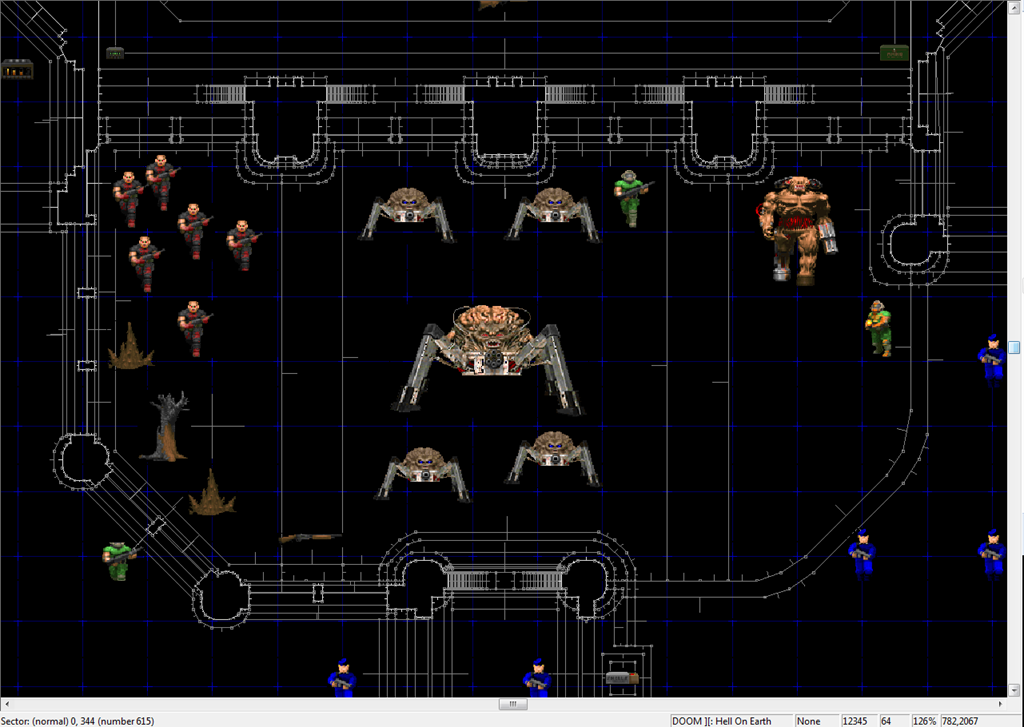
A few weeks ago I mentioned Doom Builder as a WAD editing utility for Doom maps, but after much unsuccessful attempting to work on WADs, both creating my own maps and editing existing maps, as well as crashing of the utility, I went back diving for a new tool. I came up with Wad Author, which is a much stronger tool. The only problem I have had with WadAuthor so far is that is has no visible way to search for an element in the map, so I still have Doom builder installed for that (more of a cheat some days than an editor).

wadauth


I have only edited WADs in Wad Author, but it seems like it would be easier to build new Wads in as well.

AAS in Computer Programming Substitutions

Got an e-mail back from my Computer Programming advisor, quite unexpectedly (since it is Sunday evening). Apparently she felt my inquiry was quite important. Now I am worried though, she forwarded my questions to the chair of the department, who is also presently my C# instructor. I am a little uncomfortable with the questions going to him since I do not think he likes me. I also asked the questions quite hypothetically and with limited seriousness, since I do not feel compelled to complete the degree at this time, and do not have my evidence for waivers and substitutions prepared.

I guess so much for hypothetical and “just asking”.